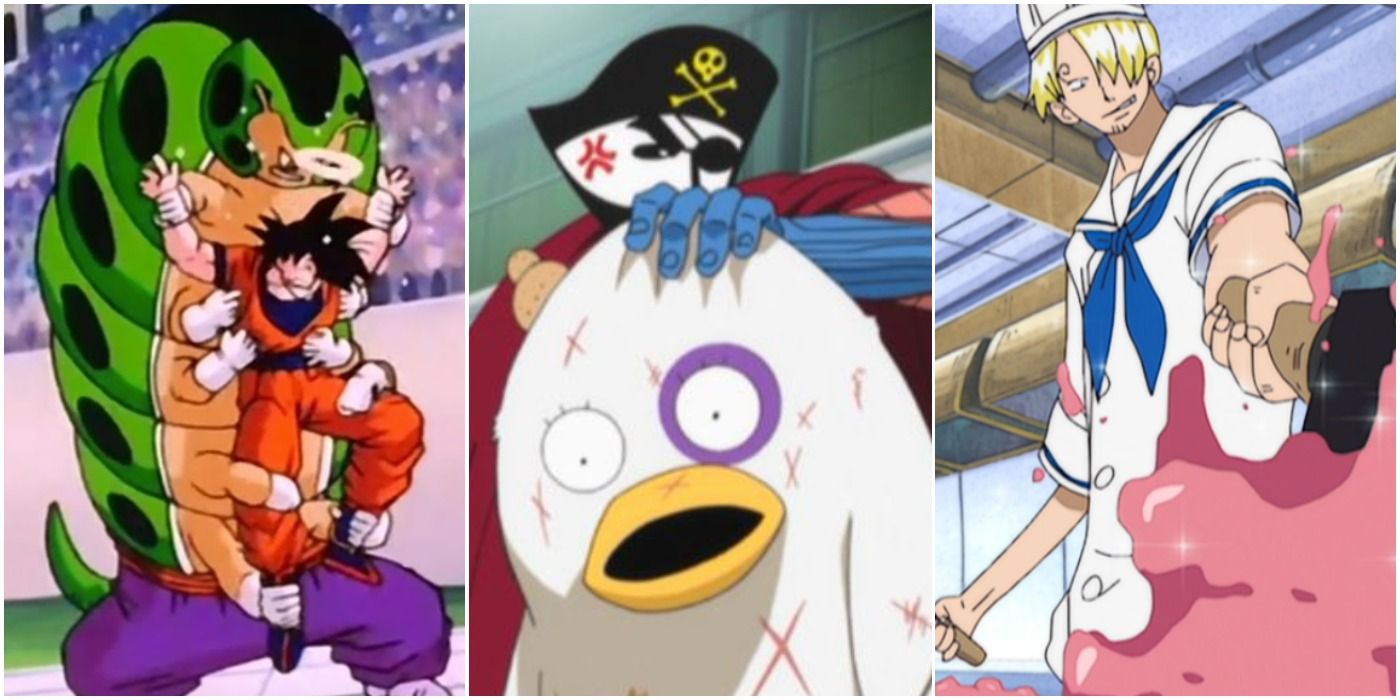
Many anime are adaptations of popular manga and filler is when the anime needs to create original material in order to progress the story without touching the main plot (usually used to pad out the season to extend the number of episodes needed to tell the story.) Filler is aptly named as it “fills” in the gaps between plot-related episodes.
Filler is especially a problem in many of the longer running shonen series, but it’s prevalent all over the place. Filler often derails momentum and comes across as inconsequential content, but it’s not always irrelevant and sometimes filler material can even surpass the main narrative.
10 Dragon Ball Z’s Other World Tournament Showcases Deceased Champions
Dragon Ball Z is an anime that’s subject to both some egregious examples of filler as well as manipulative methods to drag out battles to unreasonable lengths. Many of these experiments are misguided, but one of the winning ideas follows immediately after the conclusion of the Cell Saga and details Goku’s return to the afterlife.
The Other World Tournament is basically a World Martial Arts Tournament, but exclusively for the deceased. It doesn’t just introduce Pikkon, an exceptional fighter, but the other quadrants of the universe and their respective Kais.
9 One Piece’s G-8 Arc Allows All Of The Straw Hat Pirates To Let Their Hair Down
It’d be impossible to have a discussion about filler in anime without touching on One Piece, a series that’s seriously close to breaking 1000 episodes and still has plenty of momentum left in it. One Piece is full of its share of both strong and weak filler, but it’s usually more consistent.
The G-8 arc doesn’t overstay its welcome with just over ten entries, which are well balanced to feature the entire Straw Hat crew as well as flesh out some compelling new villains, like Captain Jonathan. It has the perfect mix of silly scenarios and exciting fight sequences.
8 Bleach’s Zanpakuto Rebellion Saga Looks At The Bond Between Weapon And Warrior
Bleach begins as one of the crown jewels of the shonen genre, but it becomes so bogged down and derailed by filler material that the anime never even gets to finish adapting the manga’s full story. Filler prematurely kills Bleach, but not all of it is a frustrating experience in the anime.
The Zanpakuto Rebellion is an entertaining change of pace that centers around the threat of sentient swords that begin to refuse the commands of their shinigami. The idea of consent and power behind the weapons that these characters regularly use to deal with death becomes a surprisingly rich digression.
7 Yu-Gi-Oh!’s Exploration Of Doma The Dark Organization Opens Up Duels In New Ways
Yu-Gi-Oh! doesn’t mess around when it comes to its filler saga and its Waking the Dragons/Doma the Dark Organization filler is nearly 40 episodes of original material that bridges the gap between the anime’s Battle City and Pharaoh’s Memories arcs. The reason that this story works so well is because it introduces a powerful new collection of Orichalcos cards that bring new mechanics into duels.
The filler just provides more excuses for tense duels with intense villains, but there are enough changes to the formula that it feels more refreshing than a lot of the core material.
6 My Hero Academia’s Sole Filler Entry On Internships Is An Absolute Triumph
Plenty of anime take severe liberties when it comes to how they adapt the source material manga, but My Hero Academia is a show that sticks incredibly close to the original and doesn’t try to rock the boat. The sole exception of this is a filler entry in season two, “Everyone’s Internships,” which cleverly expands upon a neglected area around some supporting characters.
The filler entry takes place during Midoriya, Todoroki, and Iida’s attack on Stain, so “Everyone’s Internships” focuses on the activities of others like Tsuyu “Froppy” Asui as they acclimate to their new internships.
5 Welcome To The NHK’s Offline Meeting Arc Explores The Anime’s Unflinching Themes
Welcome to the NHK is a tender anime series that’s one of the better dark comedies that explores the reclusive phenomenon known as hikkomori. Welcome to the NHK is equal parts emotional and dramatic, but the anime actually forges its own path and produces a lot of filler material as a result.
The most satisfying of this material is the anime’s Offline Meeting Arc, which fearlessly broaches dark depressive territory. Satou tries to remove both himself, and others, from a dangerous pact, and this original content is a beautiful reflection of the complex ideas that drive Welcome to the NHK forward.
4 Fairy Tail’s Changeling Filler Indulges In Classic Body Swap Shenanigans
Fairy Tail is a shonen series that takes some time to find its groove and its protagonist, Natsu Dragneel, initially leaves a lot to be desired. Fairy Tail can sometimes get a little too serious for its own good, but the “Changeling” filler entry is the anime at its most playful.
There’s nothing new about a classic body swap dilemma, but it’s still incredibly entertaining to watch the entire Fairy Tail Guild stress over this destabilizing predicament that manages to turn into an unusual bonding exercise.
3 The Excalibur Arc From Soul Eater Introduces An Extremely Controversial Character
Soul Eater is a fun shonen anime that’s immersed in the world of shinigami and the art of reaping souls. Soul Eater’s Excalibur filler episodes remain very polarizing and audiences either instantly adore the chaotic Excalibur, otherwise known as Elder God of Madness Born From Rage, or they can’t stand his annoying antics.
This is the whole point of Excalibur and he’s supposed to be so unpleasant that no one can control him. In some ways, it feels like the Excalibur episodes are Soul Eater’s way to troll the audience, but in the best way possible.
2 Gintama’s Fake Ending Scam Is The Perfect Example Of Anime-Original Content
Gintama is an anime that has over 350 episodes, but there are a surprisingly very small amount that actually qualify as filler. Gintama is so absurd that these episodes don’t even stand out as filler. Most of these entries take advantage of the anime medium and episode 150, “If You Can’t Beat Them, Join Them,” sees the main characters try to haphazardly throw a series finale together way ahead of schedule.
Each of these hypothetical conclusions are pure gold, but the fact that the mascot of Shonen Jump has to intervene to keep the anime running is a sublime conclusion.
1 Fullmetal Alchemist’s Phantom Thief Filler Turns The Anime Into A Hard-Boiled Mystery
There are examples of anime that succumb so badly to filler that they fundamentally change the source material and a reboot needs to take place to properly do the manga justice. One of the most famous examples of this is Fullmetal Alchemist and there’s really not much reason to watch the original anime over its more faithful and less filler-filled Fullmetal Alchemist: Brotherhood.
The entirety of Fullmetal Alchemist contains frustrating new content, but one of the more enjoyable outings is an ode to the mystery genre and old detective stories. The Phantom Thief becomes a fantastic character that deserves better.
About The Author