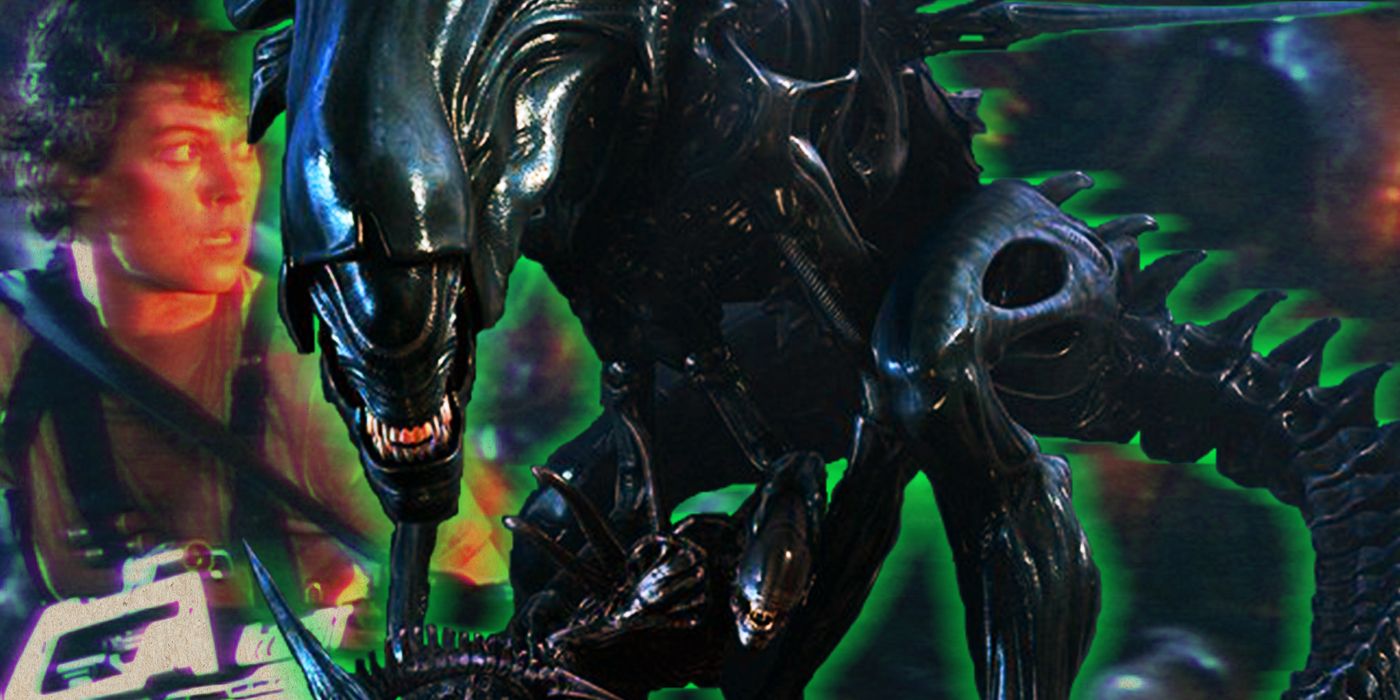
Aliens holds an untouchable place in the film pantheons of both horror and action. James Cameron‘s 1986 follow-up to Alien was a blockbuster win and only the director’s third major feature. With university-level analyses of the film’s themes and impact widely available, it’s difficult to find something new to discuss, beyond how beloved Aliens is. But there is one overlooked detail: The climax opens up space for Aliens to be recognized as an honorary kaiju classic.
It’s an unforgettable sequence. Ripley has rescued Newt from the Xenomorph nest and escaped the nuclear explosion that consumes the doomed colony of Hadley’s Hope. Given only a minute to catch her breath, Ripley, Newt and the friendly artificial person Bishop quickly discover the Queen has hitched a ride up to the U.S.S. Sulaco. Desperate to protect what remains of their families, the Queen and Ripley square up for what becomes a one-on-one smackdown, when Ripley activates the mech-style power loader.
Click the button below to start this article in quick view.
It’s not a fair fight; the Xenomorph Queen is still larger and more agile than Ripley’s quasi-armored suit. But it helps, and Ripley triumphs. For monster fans, the size disparity between the two combatants, plus the scale of the Queen herself, is a gray area when discussing whether this allows the alien to qualify as a kaiju. At 4.5 meters (15 feet) tall, the Queen is smaller than any kaiju in the Godzilla franchise. She’s roughly about as big as the baby monster born from Pacific Rim‘s Otachi, described in the novelization as about the size of two bull elephants. It allows the Queen to qualify, if on a technicality.
There are two other categories that kaiju often have to fit to satisfy traditional fans, although it’s debatable on how firm the boundaries are. Kaiju movies are often allegorical, a point hammered home by dozens of Godzilla films intended to remind society of the power of nature and the dangers of human destruction. Kaiju are also often based on supernatural concepts, and many of the classic ones are inspired by Japanese myth or yokai spirits.
The Xenomorph Queen qualifies as a kaiju on both counts. Aliens is, among other things, an allegory for the unwinnable war, a conflict in which a supposedly superior force is cleanly defeated by an enemy in its natural element. Cameron has discussed the Vietnam War and its use as an allegory in a number of interviews. As the franchise continued, the Xenomorphs became entwined with deliberately religious imagery. David Fincher’s poorly received Alien 3 has religious-horror overtones, with its prisoners calling the beast a “dragon,” a common Catholic bit of demonic iconography.
Ridley Scott brought those religious themes home in Prometheus and Alien: Covenant, with the Engineers and their cathedral-like map rooms and the memento mori-styled urn rooms. So, while some of the work was added later, the Xenomorph Queen still benefits from the symbolism. Of course, her fight with Ripley is a war for motherhood as well, a spiritual mirror to the morbid themes of sexual assault in the original Alien. As a bonus, while Ripley’s power loader is hardly a Gundam, it is a type of mecha. While not as impressive as Pacific Rim‘s later match-up of Gipsy Danger and Slattern, the pair is still trapped in a desperate human-versus-machine struggle.
While it can’t be definitively argued that any kaiju elements are in Aliens on purpose, Cameron’s love for Japanese media is well known. Although directed by Robert Rodriguez, Alita: Battle Angel had been a passion project for Cameron throughout its long pre-production, and Cameron is also one of legendary director Mamoru Oshii’s (Ghost in the Shell) biggest Western supporters. Whether Aliens is a kaiju flick at heart is up to fans, but Cameron himself probably wouldn’t mind the honor.
About The Author
