For the most part, long-running comic book franchises don’t shun their histories. It’s how they maintain popularity among its fans and new readers.
It’s why going back to the earliest issues of a comic is important for those seeking to explore the lore and legacies. A great example of this is the silver age Avengers comics. Though the writing and art might seem rougher than today’s styles, the team’s Silver Age stories have influenced generations of current creators. Furthermore, they established origins and enemies that continue to be important even in modern editions.
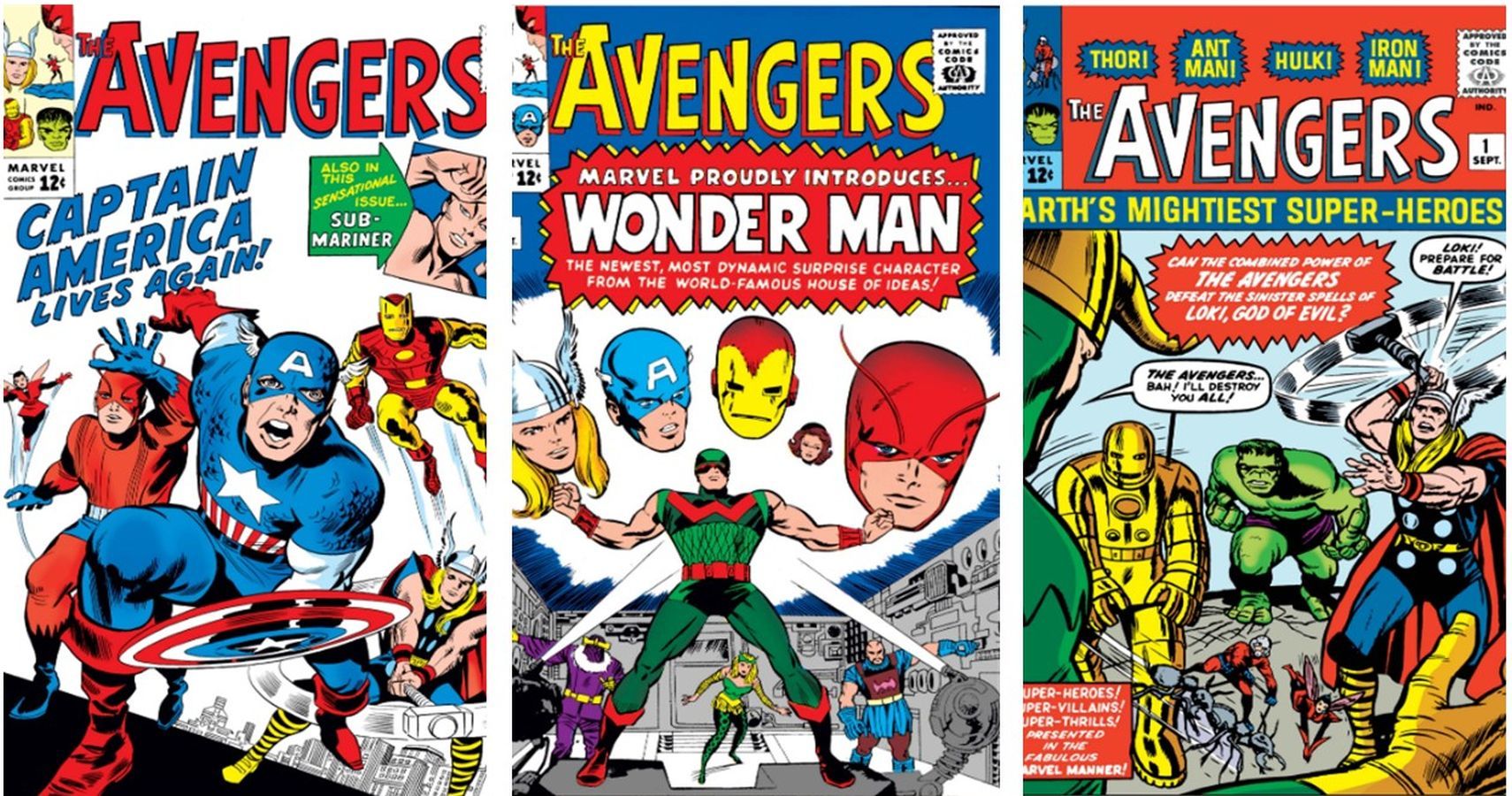
10 Avengers #1 (1963) Presented The Origin Of Marvel’s Premier Team
It took Marvel a while to develop a super team like DC’s Justice League of America. They started with the Fantastic Four in 1961, yet, the concept was family-related. It wasn’t until Stan Lee and Jack Kirby published Avengers #1 in the fall of 1963 that Marvel was able to compete with the JLA.
From the iconic first page where a solemn Loki overlooks the craggy rocks of Asgard, readers knew this was going to be a different team book. Lee’s writing and Kirby’s dynamic art made the Avengers’ origin story almost cinematic. It also signaled that there was a new superhero force available when Reed Richards and his team were adventuring.
9 Avengers #4 (1964) Introduced Captain America To The Silver Age
Avengers #4 is a momentous comic by Lee & Kirby. However, it’s not due to another team adventure. In reality, Thor, Iron Man, Giant-Man, and Wasp only appear at the start and end of the book to battle Sub-Mariner.
The rest of the book focuses on Steve Rogers’ return to the living after being frozen under the ocean for decades. Eventually, Cap ends up teaming with the Avengers to rescue them and get the leg up on Namor. At the end of the story, Iron Man invites Captain America into the Avengers, thus beginning a long and fruitful relationship.
8 Avengers #6 (1964) Reveals The Masters Of Evil As The Team’s Arch-Nemesis
On the first page of Avengers #6, Lee & Kirby tell their readers not to damage the comic because it’ll be one they want to keep. What they said is true. Not only does the issue introduced a long-time nemesis for the Avengers but brings back a villain Captain America battled during World War II.
Baron Zemo is the evildoer. Living in a jungle for decades, he discovers the Captain has returned to the living. To put an end to the hero once and for all, Zemo puts together a team of his own that includes the Black Knight, The Melter, and Radioactive Man. Though these Masters of Evil initially get the upper hand, the Avengers find a way to take the team down. Yet, Zemo declares they’ll fight another day.
7 Avengers #8 Was The First Appearance Of Kang The Conqueror
Today’s readers know that Reed Richard’s father, Nathaniel Richards, is the time-traveling villain by many names. Though he was introduced in Fantastic Four as Rama-Tut, Avengers #8 by Lee & Kirby was Kang’s first appearance.
It would set up future encounters with the villain whose goal is to control time. After being called in by the Pentagon to investigate an alien ship, the Avengers are beaten by the seemingly invulnerable Kang. It takes the teamwork of Wasp, Rick Jones, and the Teen Brigade to rescue the team’s most powerful members. Two issues later, the Avengers would encounter another version of Nathaniel in the form of Immortus.
6 Avengers #9 (1964) Introduced Future Avenger Wonder Man
Immortus would play an important part in Avengers history by introducing a future member. However, before Simon Williams joined the team as Wonder Man, he would be a part of a new Masters of Evil lineup. One that included Enchantress and Immortus.
Written by Lee and drawn by Don Heck, Avengers #9 pitted the team against a more powerful group of Masters. Especially Wonder Man, who was endowed with ionic energy by Zemo. In a fortunate turn of events, Simon realized he was being manipulated to perform evil. Instead of killing the Avengers, he helped defeat the Masters of Evil. In doing so he sacrificed his own life. Readers would later learn that Iron Man electronically saved Wonder Man’s brain patterns.
5 Avengers #16 (1965) Presented A New Lineup
The Avengers lineup remained steady for nearly a year-and-a-half. However, after battling the Masters of Evil for the umpteenth time, Iron Man, Wasp, and Giant-Man decided to take a leave of absence from the team. Perhaps even disband it.
Hence, the introduction of Cap’s Kooky Quartet in Avengers #16 by Lee & Kirby. It begins with the induction of Hawkeye as a replacement. Soon enough, Scarlet Witch and her brother Quicksilver join the team. Once Captain America returns from a mission against Baron Zemo he is named leader of the new group. One that needed to prove their worth.
4 Avengers #28 (1966) Welcomes Back Hank Pym And The Wasp
The vacation of Wasp and Giant-Man was short-lived. A dozen issues after they left, both members returned to the team full-time in Avengers #28. Unfortunately, it was due to Wasp’s kidnapping by the Beetle and the Collector.
In an issue by Lee & Heck, Giant-Man’s alter ego, Hank Pym, asks for help from the Avengers to rescue Wasp. Along the way, he needs to prove to the team who he is. Once done, he’s provided with a new costume and name — Goliath. Even after Wasp is saved there’s still an issue. It seems Hank’s powers of growth have gone awry. Though they returned to the lineup there are still some issues to resolve.
3 Avengers #52 (1968) Sees Black Panther Join The Team
Avengers #52 is only a team book by name. In reality, the story by writers Lee & Roy Thomas and art by John Buscema is a Black Panther solo story. One where he needs to find out who apparently “killed” the Avengers.
Wearing a costume similar in design to that of DC Comics’ Wildcat, T’Challa breaks into Avengers Mansion and finds the team members seemingly deceased. Arrested for being the alleged killer, he breaks out of custody to find the true culprit, The Grim Reaper. His heroics encourage the team to nominate Black Panther as a new member.
2 Avengers #57 (1968) Is The Initial Appearance Of The Vision
Those who have previously read Avengers #57 and others of the late 1960s might have noticed a shift. Another Lee, Thomas, Buscema production, it featured the storytelling and artistic styles fans would get used to in the 1970s. It also included the first-page introduction of the Vision.
From there, Lee & Thomas put together a mystery of who the Vision is and why he was assigned to kill the Avengers. Eventually, after a battle between the team and the synthezoid, Vision realizes he was sent on the mission by Ultron-5. He ends up defeating the artificial intelligence. In a poignant and famous ending, Ultron’s head is picked up and played with by a teen. Meanwhile, each panel is enhanced with a stanza from Shelly’s poem Ozymandias.
1 Avengers #70 (1969) Pits The Team Against The Squadron Sinister
Technically, The Squadron appeared in the final panel of Avengers #69. However, they got the full treatment in the next issue from the writer-artist team of Thomas and Buscema. It would be the first appearance of many for this evil team and their heroic counterparts, the Squadron Supreme.
It’s not a coincidence that Dr. Spectrum, Hyperion, Nighthawk, and Whizzer had powers similar to members of the Justice League. They were a pastiche of that DC Comics team. In the issue, the original Avengers lineup, along with members Goliath and Yellowjacket, fight individual members of the Squadron in different timelines thanks to Kang.
About The Author