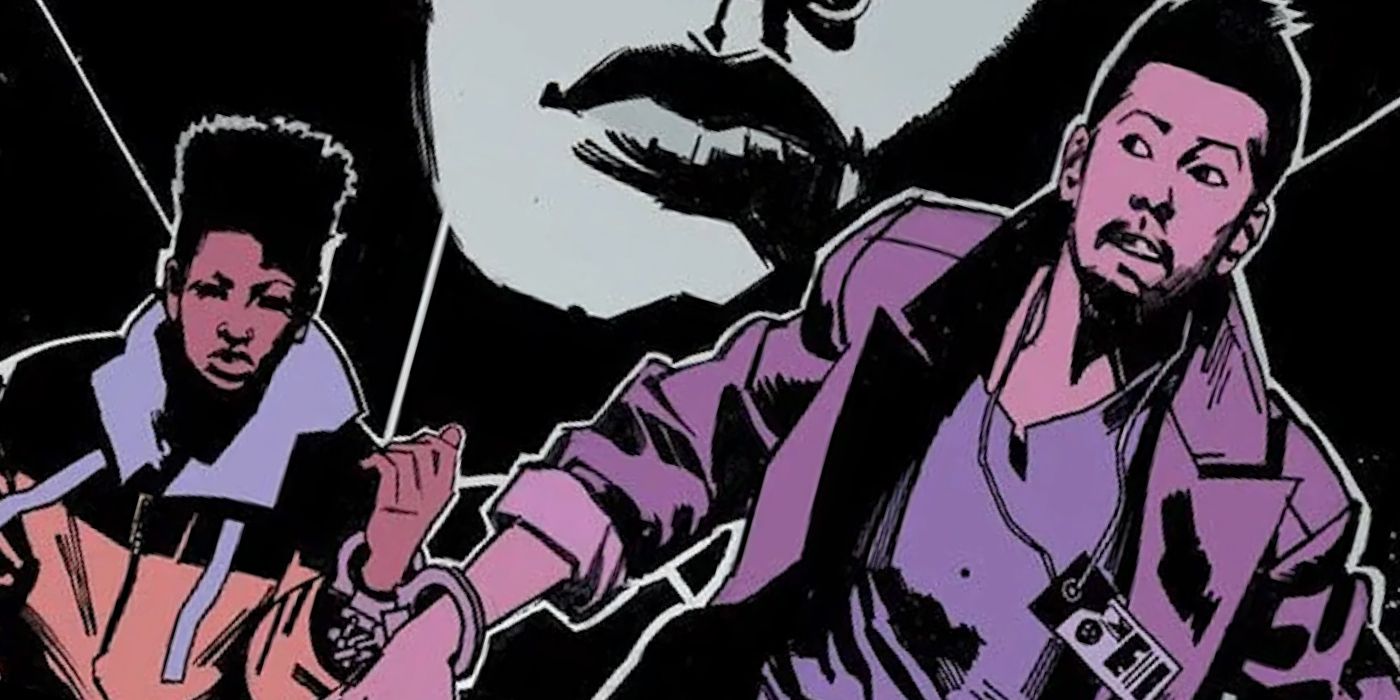
After co-creating acclaimed Image Comics titles including Savage Town and Bog Bodies, fan-favorite comic book creator Declan Shalvey is launching Time Before Time, a new ongoing series this May. Co-created with Rory McCanville and Joe Palmer, the creative team behind the hardboiled crime comic Write It In Blood, the new series follows a powerful crime syndicate that smuggles people back to different points in time to live out an idyllic life… for a price. In addition to the standard comic launch, the creative team has also launched a Kickstarter campaign for a process edition to allow fans see a full behind-the-scenes look at the creation of the new series.
In an exclusive interview with CBR, Shalvey shares the inspirations behind his new Image Comics series, the decision to Kickstart a process edition to the book, and what fans of his previous work can hope to expect when the series launches this May.
CBR: Where did the origins of Time Before Time begin?
Declan Shalvey: They began at Thought Bubble. I was at my table and Rory McConville came up to my table and I’ve known Rory for years…Rory had a Zuda comic out when he was 17 or something so he’s been doing comics for a long, long time. It was annoying me that he hadn’t done any U.S. books, and I had a lot on my plate so I said “Do you want to do something together? I don’t have a lot of time but I want to write more.” And we both like similar things so we started talking. I wanted to do a sci-fi book and my favorite sci-fi is about something that isn’t the plot. You can do fun, high-concept stuff with crime too and I also wanted to do something that isn’t straight crime because I’ve already done that with a couple of graphic novels writing-wise.
I wanted to do a mainstream comic book; crime — which is huge in film and television — is in every medium but comics is a hard sell. The weirder ideas and more high-concept stuff is more mainstream in comics so I wanted to try something like that but I knew it would be a lot of work, and I didn’t have the mental bandwidth to do it all on my own. Me and Rory started talking and we came up with this story about immigration using time as geography, effectively. We’re also talking about a lot of high-concept stuff but drilling it down more to a crime story because I know him more to be a sci-fi writer but the things we like more in common are Fargo and Better Call Saul; all our connections are more crime-based. So we drilled it down to more of a crime, sci-fi story and that’s when it really clicked; it was really just bouncing stuff back-and-forth with Rory.
We came up with the idea and Rory had been working with Joe Palmer on Write It In Blood; I was doing Bog Bodies and he was doing Write It In Blood at the same time. We were both doing these indie crime books and I loved his work on that and as he was finishing up, with Chris [O’Halloran] coloring and Hassan [Otsmane-Elhaou] lettering, I told Rory that was such a great team so why don’t we just keep them? It’s worked out great!
This is your first time with a co-writer. How has that been on a creator-owned title?
Shalvey: It’s been interesting. It’s saved me a lot of time as [compared to] if I was doing it on my own, but it’s also interesting to see what Rory comes back with because it’s stuff that I wouldn’t have thought of and it’s really, really good. And finding a way to work, I’ve spoken with people that have done co-writing and some of them have very different ways of doing it. I said we were going to write something together, but I had no idea how to do it so a lot of conversations have been how we’re just going to figure it out. We ended up coming up with a nice flow, and I’ll come up with ideas and Rory will edit them out and I’ll ask if he just didn’t like them. [Laughs]
You’ve got to leave your ego at the door, but it’s also tough because you’re trying to find a consistent way to produce it and there’s a lot of back-and-forth whereas, if I was doing it on my own, you’d just make a decision and it’s done when I pass it to somebody else. So there’s been a lot of fine-tuning it into something better.
This is a crime comic, but you’ve also got that whole time-travel aspect. How is it taking those two elements and blending them together?
Shalvey: It doesn’t really feel like I’m blending two things together; Looper has been mentioned a lot in [promotional material] and it was definitely in my head in that I loved it was a very street-level, drama story with all the advantages of genre storytelling. I love crime stuff, but what I love about genre is you can do much more fantastical things and using time-travel is a really great way to heighten that drama. You can put somebody in prison and have them come out the next day as an old man, that has a lot of drama potential; it’s giving us grace and shortcuts to heighten the dramatic elements. It’s not really that high-concept, it’s fairly low-tech; the time-travel rules we pare down to make it something more understandable. The device of traveling through time is just what creates these dramatic barriers that we’re crashing through. It doesn’t feel like we’re forcing it, it really happened quite naturally.
In addition to the standard release, you’re also doing a Kickstarter campaign for a process edition. What made you want to invite readers in to see how the sausage is made?
Shalvey: A friend of mine suggested it as a good promotional tool and I thought it was a good point if we had something we could talk about for a straight month as part of a campaign. I’ve marketed different books differently, like I did with Savage Town and Bog Bodies, and we have a product that I hope does really, really well and it can be frustrating having extras in trades because it’s expensive to have more paper and you never really get to dig in the way you’d like. Why instead of forcing that into a trade we put it in something where we can really dig in? I personally love director’s cuts, commentaries, all that stuff, but I know I’m not necessarily the mainstream audience so Kickstarter seemed like a great way to see if it was an idea people would be into and be a good way to spread the money for the book to the creators.
There were three reasons to do it: It would be interesting creatively, it wouldn’t cost us money as long as we could fund it, and it would be a great way to dig into process stuff without having to go the direct market way where you’re putting out a book where you have no idea if it’ll sell and you don’t make your money back. It just seemed like a more financially responsible, creatively interesting and promotional tool. It’s been a lot of work, though!
I felt like Kickstarter was something people like me shouldn’t use, people who have resources, like publishers, but COVID changed things. I wasn’t planning on doing a Kickstarter, but friends of mine were, and I could see how beneficial it was that, if you have an audience and they can pay for the book while you work on it, that’s a great option to have as a creator. No matter if you’ve done books for Marvel, DC or Image, it never hurts to have a backup plan; that’s what changed my mind about it. I saw Elsa Charretier’s sketchbook and my friend Stephen Mooney’s Half Past Angel. Selling anything niche is hard in the direct market so selling something that’s even more niche is an uphill struggle so Kickstarter seemed like the best way to make that happen with the most possibility of not losing money. [Laughs]
As someone that’s an artist yourself, I’m always curious how it is working with other artists. And what made Joe the perfect artist for this?
Shalvey: With previous work, I wanted to work with Irish artists and give them a spotlight on work that I like and wanted to give a spotlight; I’m not entirely altruistic. [Laughs] Savage Town and Bog Bodies were both ideas I wanted to make happen whether or not they were successful. This is different, those were graphic novels and those are harder to make your money back because it’s a much different market. This is me not trying to make an indie movie but make a mainstream TV show, for lack of a better analogy.
So possibilities were much more open for artists but I also didn’t want to do something that looked mainstream because I think the best Image have a really strong identity and bold artists really accomplish that. I was guiding the guys along on Write It In Blood as a de facto editor of sorts and the work that Joe was putting in the book, his character work was great, there were really moody shots. I just did a piece for the Kickstarter that was a layout of his that I drew over and what I really respond to is his compositions are great. He’s really great with negative space and he’s more pared down and stylistic than I am…he has a much more exaggerated way than I would but he does it so well.
I think because his pages are so well-designed, it just works really, really nicely and he did really grounded story with Write It In Blood and I knew, with Time Before Time, it would have to be really stylized; we’re showing the future, we’re showing technology. I didn’t want it all to look pedestrian and Joe’s anything but. I saw Write It In Blood and knew if you gave him something like Time Before Time, more imagination would be needed and we’d be reward and that has definitely been the case. Also, Joe was available, no one knew who he was so I took advantage of that. [Laughs] Any writer knows how hard it is to get a good artist and Joe is on time, he got stuff in early, he is such a trooper and so good. I don’t think he had anything lined up after Write It In Blood and having an artist who’s reliable and great to work with is not as easy as you would think and I didn’t want to let him go.
Both Bog Bodies and Savage Town were graphic novels, one and done, and Deadpool vs. Old Man Logan was only five issues. How is it building a longer-form, serialized story with this?
Shalvey: What I wanted to do with the book was build the machine that is a monthly book and have a concept and kind of mess with it. That’s not what a done-in-one story is and I wanted to take advantage that this concept has legs. There’s really interesting places we can go, and I had an idea for Issue #6, we’re going to do something different with that one. Creatively, it’s really fun to go with the book that we have and then do something really interesting other than just put out the next part. Me and Rory were talking about the second arc, and we got really excited about where it could go after that.
The problem is, being frank, I have no idea if we’re going to be able to get past the second arc; I didn’t know we’d get past the first arc until recently and we’re trying to do our best to seed enough big ideas that we may be able to pay off down the line while also trying to keep in mind that the finish line may be put in front of us if the book doesn’t sell the way we need it to; that’s frustrating. The benefit of doing a Marvel book is you’d get one and be able to do it for a number of years and that’s not always the case anymore and I, creatively, wanted to be able to play in a certain playground for as long as possible. That’s the tough thing, being able to play but not knowing when your mother is going to call you in. [Laughs] That’s where we are delicately now, it’ll all come down to sales and who the hell knows, but I am excited about where we’re going after the first arc ends. The benefit is I tend to write to the format so we’re writing the book and trying to squeeze as much out as we can.
What do you think fans, especially of your past work, can expect and hope for?
Shalvey: I think if you are a fan of my past work, be it Moon Knight or Injection or whatever, I’d like to think anything I work on has a certain aesthetic. I’m doing the covers and Sasha [Head] is designing it and it looks different than anything I’ve done before but I hope to a consistent feeling to the book to the work that I do. And I’m hoping that they can have fun in the playground that we’re making that I haven’t been able to do with anything else. Anything I’ve done longer is something I’ve drawn, not written, and I’m really enjoying building this world that I don’t have to draw. [Laughs] And it’s really fresh seeing Joe’s work come back doing stuff I wouldn’t, it’s keeping me on my toes as an artist as I’m drawing other things. What I can promise people is it’s going to be a damn good comic, brilliantly illustrated, in tone with the work that I’ve done before and hopefully pushes us into new places.
Written by Declan Shalvey and Rory McConville and illustrated by Joe Palmer, Time Before Time #1 goes on sale May 12 from Image Comics.
About The Author
