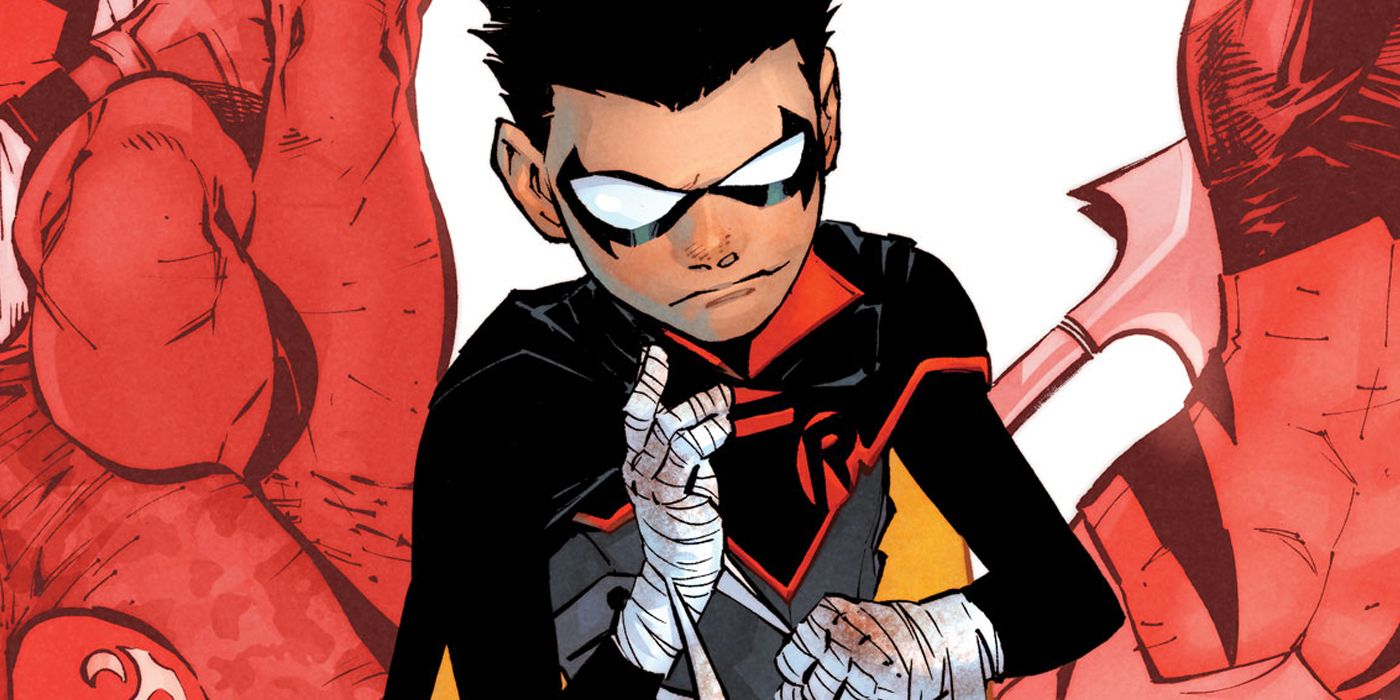
As teased in the backup stories in Batman and Detective Comics, Damian Wayne is set to embark on his most dangerous adventure yet by taking part in the fateful Lazarus Tournament. While this will give him the opportunity to potentially learn more about the mysterious League of Lazarus, Damian will have to confront plenty of threats, both old and new, along the way, as he comes to terms with the person he has grown into.
During an exclusive interview with CBR, Robin writer Joshua Williamson delved into the key to creating new characters in the DC Universe, what it was like to bring Connor Hawke back into the fold, and teased some of the familiar faces readers can expect to see over the course of the upcoming Lazarus Tournament. CBR also has a look at one of the first battles of the tournament in Robin #1, by Williamson, Gleb Melnikov and Troy Peteri.
CBR: I don’t know about you, but I’m a sucker for a good “fighting tournament” storyline.
Joshua Williamson: Yeah, me too! It’s funny, when I was pitching [Robin], I really was like, ‘Well, I want to do this book.’ I’m going to do this really fun thing, something that I would love to read. That’s always one of my rules of making comics, is making sure it’s something that I would enjoy. And I was like, ‘What if we did a tournament?’ I pitched the whole thing, and DC really went for it, and it has been the most fun I’ve ever had working on a comic. Honestly, I love Damian, and they just let me get away with all these characters that I really like. I was putting Ravager in there and then putting Connor Hawke in there, having some of these other smaller characters that haven’t been around in a while. It’s been super fun.
CBR: How did Connor Hawke end up making his return in this storyline? Did you pitch him directly when you were first selling DC on the concept?
Williamson: Yeah. When we first started talking about doing the book, and we started talking about the tournament and what Damian was going to be going through — because of Connor Hawke and his own past and his own history and being this amazing hand-to-hand fighter — I was like, ‘Oh, I have to have Connor Hawke.’ Connor Hawke hasn’t been seen in the DC Universe in like ten years, and I always liked that character. I was always bummed that [Connor] got shoved to the side. And so I started just asking, I was already asking about Ravager and other ones, but I really felt like I needed Connor. I was piecing all these things together with him and Damian, and at the same time, I was thinking about who were the people who would have these kinds of competitions.
When you look at something like Court of Owls, part of the logic of Court of Owls was that the owl is a natural predator for bats. So it works with those characters. So I was like, ‘Okay, well, I’ll take that logic and apply it to Robin. What are robin’s natural predators?’ And I looked it up and it was hawks. I just felt like all this was coming together. I went to DC and was like, ‘Hey, listen, here are all my thoughts on how I want to do it.’ And at first, I was like, ‘Well, [Connor’s] only going to be a side thing. He’ll be part of the book, we’ll slowly introduce him.’ But then once I started writing the book and I started realizing, it never clicked in my brain until I was actually writing it how much Damian and Connor have in common.
I was able to really bring him more and more in the book, and he took on a larger role. Once I started really outlining out what the whole first part was going to be, the emotional story for Damian became tied in with Connor Hawke and what Connor Hawke is going through. It jelled really, really well. Issue #3 has a big scene with the two of them that’s one of my favorite things I’ve done in a long time. It’s one of my favorite scenes in the book, the two of them having, essentially, a bonding moment where they’re talking about what their lives have been like and how much they have in common. I feel like I ran into some chemistry with the two of them, with Ravager, couple of other characters that we show. Something clicked when I was working on it.
CBR: There are going to be new characters as well — Respawn and Flatline, in particular. What do you think is the key to creating a new DC character and making them feel like a real piece of this collective universe? Is it challenging at all?
Williamson: Making new characters can definitely be really challenging. I think it has to come from an organic place. I’ve created a lot of characters for DC. and there are differences in the times where you’re like, ‘Okay, well this one’s going to fill this role for these reasons.’ And some of those new characters I created, like Godspeed and the new Speed Force users, a lot of them have made their way into The Flash. It’s surprising. Bloodwork was in the comics, and he was a big bad last year. It’s interesting, it’s an organic thing that just kind of comes. I think if you push it too hard on yourself to just be like, ‘Well, I’m going to create a character’ just because I think you can fall into some weird pits with it.
When we were planning out Robin, I started coming up with all these ideas of different fighters we were going to use — classic fighters, people we haven’t seen in a little bit — and then I started listing off all these other ideas. I was just having fun, being like, ‘What are some different fighting tropes,’ and playing around with them. I had the ones that I knew I was like, ‘Okay, Lord-Death Man was going to have a new sidekick. That’s one.’ And then I was like, ‘Oh, there’s this mysterious character that is going to be this part of the story and it goes beyond just the first arc. It’s going to go into bigger stuff with the book.’ I gave all that to [Gleb Melnikov.] He knows DC really well like I do. He has a love of certain things. I think he has a really good design sense.
Williamson: He took all those pieces, and with Flatline in particular. When Flatline came back, she wasn’t even called that at first. We didn’t have a name for her yet, but he did the design for her, he nailed it pretty much out the gate. And so then I was like, “Oh, her name’s Flatline.” Once the visual came in, then it started to really form in my head. I think that’s what made it an organic experience, making her for the book… her whole personality came because of the drawing. I had kind of an idea in my head and they were very different from what I was thinking. Then Gleb turned the design in, I was like, “Oh, I know who this character is now.’ Just automatically, ‘Alright, let’s go. Let’s get to writing.’
With Respawn, the same thing. We knew, essentially, what Respawn needed to be and what their role is going to be in the book, and how their very look is a tease. Their very look is supposed to tell you something. We talked about that a lot and Gleb just pulled it together, and we were able to start piecing the stuff together. When you’re creating these things, I think the priority for you as a creator is just to try to have fun with it. Don’t take yourself too seriously. Don’t be like, ‘I got to make the most badass character ever that’s going to be the new Doomsday.’ You got to just go out there and be like, ‘I’m going to have fun with this.’
I think that’s the key to making these things, but also to be afraid. Don’t be afraid of making a new character and just going for it. You look at something like Punchline that [James Tynion IV and Jorge Jimenez] created last year. The two of them just went for it. They were like, “Oh, we’re going to create a new girlfriend for the Joker and they’re the opposite of Harley. Let’s go.’ They weren’t afraid. A big puzzle piece you have to do when you’re trying to create a new character for DC Comics is just not to be afraid, but then make sure it’s something that’s visually eye-catching. You can see it and know what that character’s about just by looking at them.
The Lazarus Tournament is a really fun concept and a really good fit for Damian where he is right now in the DC Universe – he’s a genuine wildcard. Why do you think Damian is the perfect character to be used in the epicenter of this kind of storyline?
Williamson: Well, selfishly for me, I enjoy throwing Damian in different situations where he has to interact with people. And it might be situations where he isn’t his normal situation, where he’s such a competent person, but I think there are ways of throwing him into situations that might humble him or where he might clash with people. I love Damian. I’ve liked him since day one. I’ve wanted to write him for years. And so for me, I like that idea of him being this wildcard of the DCU and him going through this growth period in his life where he just went through a lot of really hard stuff, and now he’s taking a step back to reflect on what happened, growing as a character. Those are all the things that are important to me with him.
Damian is a person who thinks they know everything and then suddenly is confronted with, ‘Maybe I don’t know everything, maybe there’s a piece of the world I’m not aware of and it was kept secret from me. How was that kept secret from me? Why was that kept secret from me?’ And let’s throw him into that situation, the League of Lazarus, where he finds himself surrounded by all of these people that… When Damian was first introduced, a part of his story was that he was a person that was like, “I can take a life. I can do this thing. I’m the best at killing. I can do this, doesn’t matter.” And then to just surround him with people who, all these fighters outside of Connor Hawke, a lot of them are assassins. A lot of them are mercenaries who kill people.
So to suddenly find himself in that situation again where Damian’s around people who are just like, ‘Oh yeah, I have no problem killing people. You’re totally right. We should just kill people.’ Finding himself in that moment, I think, makes Damian confront a lot of parts of himself and the fact that he was raised to be a weapon. He was raised to be a weapon, to be a vessel for rage — all these things where people were just taking away who he was to make him into something else. I think being in this tournament, Damian gets to see other people who’ve gone through things very similar to him. And instead of them constantly trying to help him, I think it’s an opportunity for him to help others get through what he also went through. All these pieces just go into this big story, and then there’s a bunch of fighting.
I think one of the things I love about this book is that I got an opportunity to not worry about compression. When I was on Flash, Flash books are built to be very quick and very speedy. They move, move, move. But this one, I wanted to let it breathe. I wanted to let some of these moments with Damian breathe longer. And so that’s what I was able to do here. There’s a scene in Issue #3 where it’s Connor and Robin, and they just talk for like four pages. And being able to do that and just show actual emotion and talking about who they are. Issue #4 has Ra’s al Ghul in it, and I get to spend pages of the two of them together, which you don’t really get to see that often. We’ve seen it, but it’s always super agonistic and yelling.
I love the theater. I love going and watching people just yell at each other on stage and be super dramatic, but then you balance that out with occasionally those two characters talk for a moment. You get to see them really say what’s on their minds and really get to show themselves as characters. I wanted to spend time with that. There are moments of that throughout, where I was able to let these characters just be able to talk about stuff that’s going on, what their take is on what’s happening in their lives, how they’re changing — then that leads to fighting and punching and kicking. This book is brutal in places. I hesitate to say violent, but there’s definitely some fighting going on and people are really going at it with each other. I think it’s fun to see Damian in a situation where he knows that he can really cut loose a little bit.
CBR: How do you personally determine how these characters win? Are you trying to weigh skillsets versus each other? Or is it a little bit of really finding the drama in it?
Williamson: In my notebook, I have graphs. I have the tournament broken up, and I have who’s doing what — and not only is it who wins in these fights — but because I can figure out who fights who, the way that the tournament brackets are going to break up, eventually everyone fights each other. So it’s like trying to figure out the map of who fights who, but I don’t want to do anything where I’m cheating. I don’t want someone to win just because I want them to win. And so I go in there and I really look at, stats, history, what they’ve done, what they’ve not done, what’s happening in the book, and how are people manipulating these fights. Connor Hawke is working with the League of Shadows, and so what is he up to during all of this and how are the League of Shadows manipulating things?
I went through all that stuff, and that’s how I figured out who’s winning. It’s been tough at times because, yeah, I don’t want to cheat, and I don’t want to make it so one character gets knocked out early. So it’s a lot of,– I want to say math — but it’s definitely been on my mind of how I roll out fights across the book to show how people lose, when they win, what are the circumstances they give us there, but at the same time, making it fun for everybody. And that way, nobody’s disappointed. I’m sure people will probably be like, ‘This is one of my favorite characters. I can’t believe they lost.’ But I think there are ways of playing with it to make it feel satisfying.
CBR: So, hypothetically, let’s say there’s a Robin tournament — it’s everyone who’s been Robin, which means Cassandra Cain’s not there because otherwise, she would just destroy everyone. Would Damian be able to take down all the other Robins?
Williamson: Yeah, I feel like [Cassandra] doesn’t need to be in a tournament. Cassandra’s interesting because I think she’s a tricky character and I’ve only been able to write her once and I think she’s awesome. Her in a tournament book, I don’t think she would necessarily want to be in this particular tournament. But if I take her out of the equation and we just focus on everyone who’s ever been a Robin, my answer is to read the book… There is definitely an answer to that question that comes up in Robin. We show it, and it’s fun. There is an answer to that question.
Robin #1, by Joshua Williamson, Gleb Melkinov and Troy Peteri, goes on sale April 27 from DC.