This is “Look Back,” a feature that I plan to do for at least all of 2020 and possibly beyond that (and possibly forget about in a week, who knows?). The concept is that every week (I’ll probably be skipping the four fifth weeks in the year, but maybe not) of a month, I will spotlight a single issue of a comic book that came out in the past and talk about that issue (often in terms of a larger scale, like the series overall, etc.). Each week will be a look at a comic book from a different year that came out the same month X amount of years ago. The first week of the month looks at a book that came out this month ten years ago. The second week looks at a book that came out this month 25 years ago. The third week looks at a book that came out this month 50 years ago. The fourth week looks at a book that came out this month 75 years ago. The occasional fifth week looks at books from 20/30/40/60/70/80 years ago.
Click the button below to start this article in quick view.
Whoops, this is a day late. My apologies. Today, we go back to March 1971 for the debut of Talia al Ghul in Detective Comics #411 by Denny O’Neil, Bob Brown and Dick Giordano.
One of the interesting aspects of the way that DC comics were produced in the early 1970s is that the whole concept of “runs” on comic books was a lot different back then. In general, the ways things worked is that there was an editor and that editor would assign creators for a given issue and sometimes work out a plot idea with them. There were a number of editors who relied on the same creative team every month to create the comics, so there was certainly many examples of what we would consider “runs” on books, like Ross Andru and Mike Esposito drawing every issue of Wonder Woman from 1958 through 1967 or Curt Swan being THE Superman artist for years, but even in the case of Swan, it would be he would show up, get his assignment and draw it. It might be an issue of Superman’s Pal, Jimmy Olsen, it might be Superman’s Girl Friend, Lois Lane, whatever. He got the assignment and he did it. It wasn’t a case where the creators were really interacting with each other. The editor was the only one who overlapped. Denny O’Neil once described it like this, “I was an active comic book writer when that kind of thing was not an element– you got your foot in the door, and if you got editors who wanted to use you or if you got a reputation for being reliable or whatever, and if you showed up at the comic book offices you usually got work. It was a very informal situation– All those Batman stories I wrote I was never the Batman writer, and I never had a contract, even an informal agreement. It was just that I would show up on Thursday morning and go to Julie Schwartz’s office and he would give me a job that was often Batman.”
Therefore, when Neal Adams, one of Denny O’Neil’s most significant collaborators of the era, created the Society of Assassins in Strange Adventures #215…
it is likely that Denny O’Neil had no idea when O’Neil also introduced the LEAGUE of Assassins in Detective Comics #405 (art by Bob Brown and Dick Giordano)…
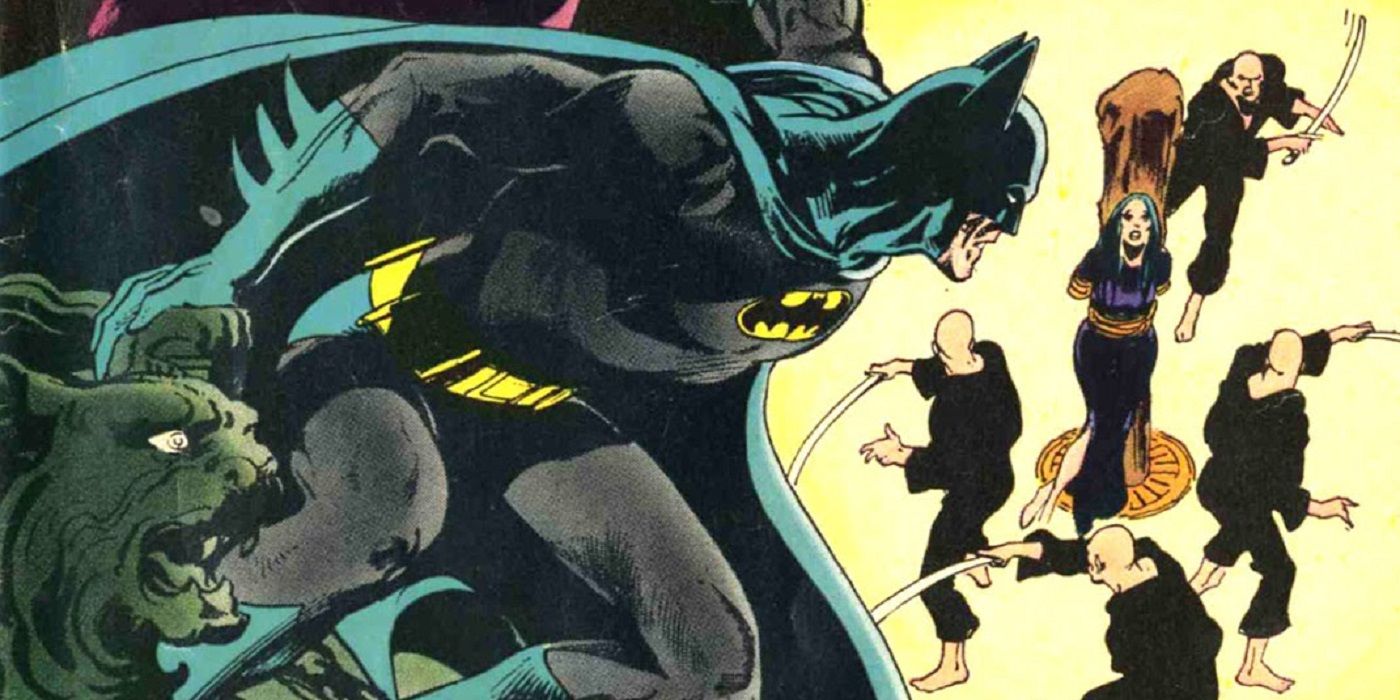
And Neal Adams drew the cover of the League of Assassins first cover! That’s how crazy the separation was on this stuff back then. We think of the “Hard Travelin’ Heroes” arc as this amazing collaboration, but when O’Neil wrote the scripts for the stories, he assumed that Gil Kane, the most common Green Lantern artist, was going to draw them! So one of the weird things about Talia al Ghul’s debut in Detective Comics #411 is that O’Neil did not know who was going to draw it. He was hoping for Adams, but instead it was the late, great Bob Brown (inked by Dick Giordano). Brown is excellent in his own right, but Adams obviously was already a hot artist. We had met Dr. Darrk, the head of the League of Assassins, and in this issue, O’Neil follows up the original League story from Detective #405-06 by bringing Darrk back, as he has kidnapped a mysterious woman. There’s an excellent sequence where Batman tracks them down in the middle of nowhere on a train and reveals himself under his disguise…
Batman is captured, as well, and when she is in their cell together, she discovers Batman’s identity and reveals her identity, as Talia al Ghul. She mentions her father, who we’ll discuss soon in the Look Back…
Batman, though, awesomely breaks free of Darrk’s traps and captures him. Darrk, though, had one last trick up his sleeve, but Talia instead kills him….
It’s fascinating how O’Neil obviously had plans for Talia’s father (as it was happening the next month), but it really is kind of unclear what the connection is here right away. Talia is an interesting character, but we don’t get a ton of information about her. Maybe things will get even more interesting in the next month!
If you folks have any suggestions for April (or any other later months) 2011, 1996, 1971 and 1946 comic books for me to spotlight, drop me a line at brianc@cbr.com! Here is the guide, though, for the cover dates of books so that you can make suggestions for books that actually came out in the correct month. Generally speaking, the traditional amount of time between the cover date and the release date of a comic book throughout most of comic history has been two months (it was three months at times, but not during the times we’re discussing here). So the comic books will have a cover date that is two months ahead of the actual release date (so October for a book that came out in August). Obviously, it is easier to tell when a book from 10 years ago was released, since there was internet coverage of books back then.
About The Author
