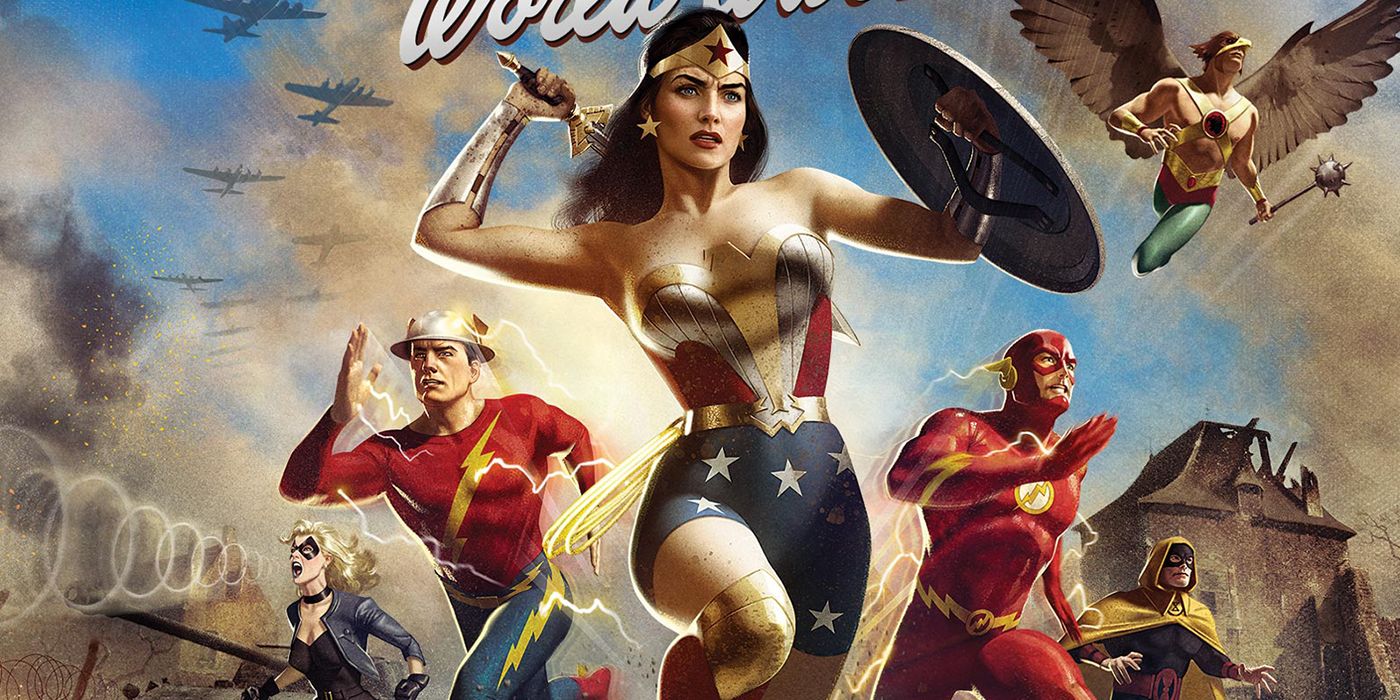
With a career in television and film animation spanning over three decades, Butch Lukic has progressed from storyboard artist to director and now to producer with the new DC Universe Animated Original Movie Justice Society: World War II. The new film has the Flash accidentally transport himself to the 1940s, where he joins forces with the Justice Society to liberate Europe from the Axis Powers while searching for a way to return back to his own timeline.
In an exclusive interview with CBR, Lukic looks back on his prolific career, talks about how development on Justice Society: World War II began as a completely separate project and touched on his lifelong love of superhero comic books.
You’ve been working with Warner Bros. Animation for decades as a storyboard artist, director and now producer. How has that transition been?
Butch Lukic: I started out as a [story]board guy there back with Batman: The Animated Series, then I left because I told Bruce [Timm] and the guys that I wanted to be a director, and if I couldn’t find that [here] I had to move on. I went to Gargoyles when they started that and Bruce tried to get me back for Superman Adventures, but I was having such a good time over there at Disney developing stuff that I said, “Screw you, I’m not coming back.” But then he started Batman Adventures, and I came back because Disney wanted me to do Hercules, and I didn’t want to do that.
So I ran back to him and worked a few years as a director through Justice League and and then I left again and worked with Glen Murakami for a while and came back probably around eleven years ago. I was a supervising director, with Glen as producer, but I finally got my gig as a producer on some of these [straight-to-video projects] and a couple series and that’s how it all came about. Honestly, I could’ve produced earlier, but I didn’t feel like it was the type of job I wanted. I really liked directing. But now that I am producing and I see the whole thing and I get to control almost all of it, I see the big difference.
We’ve seen quite a few of the JSA characters in present-day but what I love about this film is we get to see them together in the 1940s in their physical prime. How was it developing this roster and showcasing why each deserves a spot on the team?
Lukic: This was my whole intention when we had to pitch to DC storylines we were going to produce for the DC Animated Universe — obviously, we’ve got to do Batman which we ended up doing as The Long Halloween and we restarted a new version of Superman — this came about because I wanted to do a World War II story with Wonder Woman, because I initially had a pitch with DC Access to do a Wonder Woman series based in World War II. And this was before the first Wonder Woman movie came out; while we were pitching it, we found out that they were doing a World War I take on Wonder Woman. And I thought it would be good to do this as a series, but the development didn’t last long because they didn’t think Wonder Woman had legs, not until the movie came out that they realized “Oh shit, this is a moneymaker.” So I just took some of the ideas that we had for that series and applied them towards this film.
As someone who’s directed and been a storyboard artist before, how was it working with director Jeff Wamester, who also comes from a storyboard background?
Lukic: It’s great because, before I was doing movies with Chris [Palmer] who felt his time was up and wanted to move on, we both talked about Jeff, who was doing some boards for us. Obviously, he directed before and that was the better choice for me when I had to look for a new director. I know Jeff’s been directing for a few years, he has the experience, especially in action-adventure, and his boards are great. His storyboards have a sense of style, action, composition; it’s beautiful stuff. He was a no-brainer. There were a couple of guys I would’ve taken too that are great board artists in our crew, but it was dependent if they had more experience for these [direct-to-video films] to be a director: If they had more experience in TV, there was more of a chance I could’ve chosen one of them to direct one of these.
I feel like one of your secret weapons is voice director Wes Gleason and he’s got quite a history with Warner Bros. Animation too. How has it been working with him over the years and on this project?
Lukic: Wes and me go back a long time. When I started at Warner Bros., we started together. It was my first time working as a producer and his first time working in animation so everything I’ve done as a producer, I’ve always used him. When the rest of the guys saw his abilities, and they asked me about him, I wanted to say “Nah, he’s shit don’t use him,” so I could keep him to myself. [Laughs] But instead, I told them the truth and they used him too and obviously he’s been a big benefit to the studio.
This is the first time we’ve the animated versions of some of these characters but were there any Golden Age DC characters that didn’t make the cut?
Lukic: Yeah, we went through a list with a lot of the characters from that period but it was definitely down to JSA characters only. Wildcat was in the running and also the original Green Lantern but just [they didn’t work] time-wise and some of the other characters wouldn’t be along the same lines. If I could’ve added them all in and extended the movie a little bit, I would’ve done it. But if you just have the six, you have enough character to spread this out equally between. If you add any more, you really limit some of the guys’ possible sequences and scenes to make it work.
As someone that has been working with DC characters for a long time, what is it about them that keeps you coming back to this canvas?
Lukic: I think it’s the history of the characters and I’ve been reading and collecting comics since I was three or four so it’s been nonstop for me. But, like the other guys, I was a Marvel fan; that was the era that I grew up in where Marvel was dominant. But once we were at Warner Bros. and Batman got off the ground — to me, Bruce and the other guys, Batman is the greatest — there’s not much Marvel-wise that can beat Batman as a superhero.
And learning how good the possibilities are for all of these other characters in animation form, as Marvel fans, we wanted to add a little Marvel in them and I think that’s what makes the DC Animated stuff work because our sense of style is a little bit more in the Marvel manner, the way things were written and the things play out. Especially with the Justice League, we were treating them more like the Avengers before the [Marvel Cinematic Universe] versions.
Produced by Warner Bros. Animation, DC and Warner Bros. Home Entertainment, Justice Society: World War II stars Stana Katic as Wonder Woman, Matt Bomer as The Flash, Elysia Rotaru as Black Canary, Chris Diamantopoulos as Steve Trevor, Omid Abtahi as Hawkman, Matthew Mercer as Hourman, Armen Taylor as Jay Garrick, Liam McIntyre as Aquaman, Ashleigh LaThrop as Iris West, Geoffrey Arend as Charles Halstead/Advisor, Keith Ferguson as Dr. Fate and Darin De Paul as Roosevelt. The film will be released digitally on April 27 and on 4K UHD and Blu-ray on May 11.
About The Author
