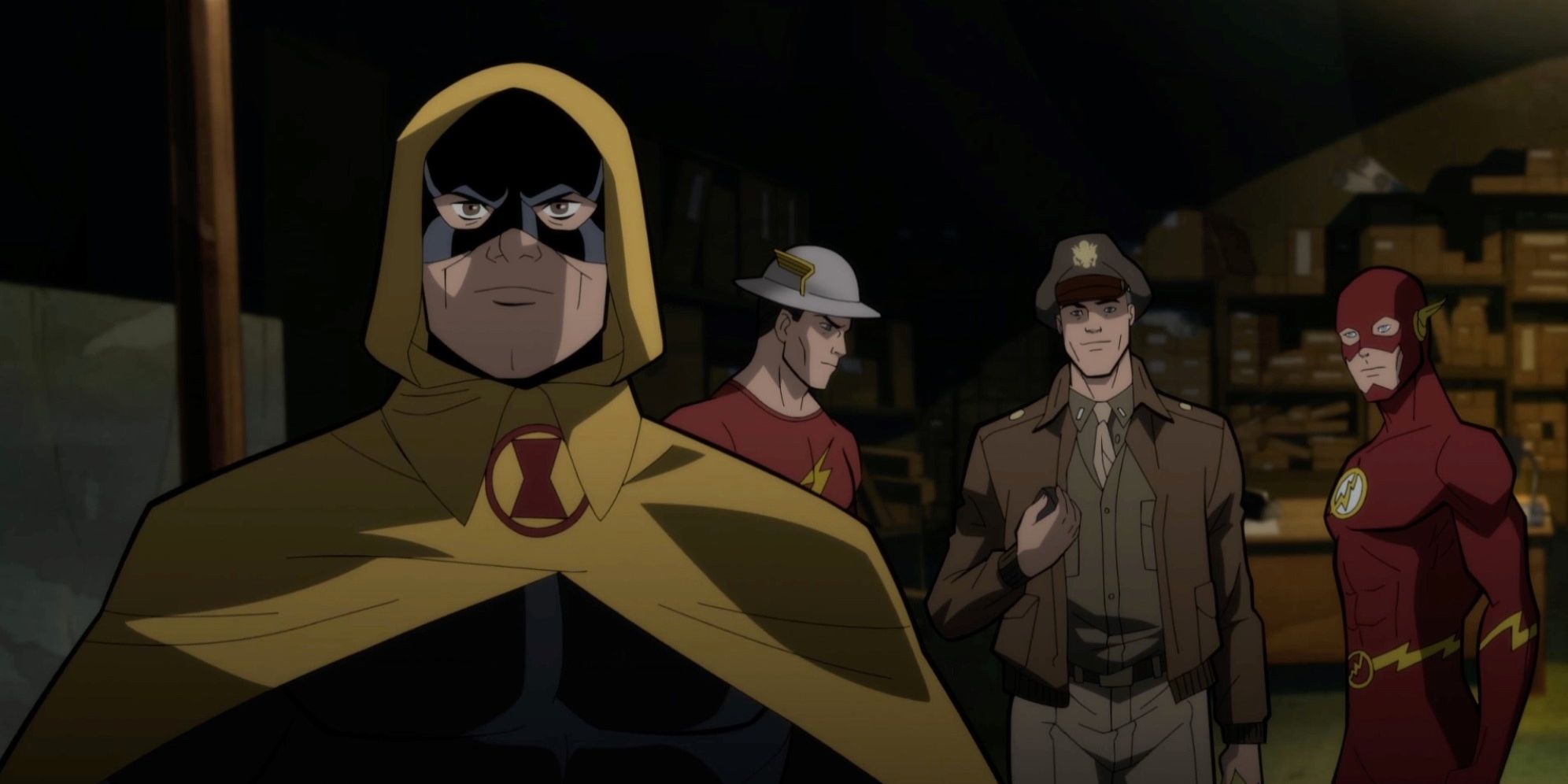
While superheroes like Aquaman and The Flash are beloved by millions worldwide, the Golden Age team the Justice Society features plenty of characters that haven’t become household names yet. Among them is Hourman, played by Matthew Mercer in the animated film Justice Society: World War II. Also known as Rex Tyler, Hourman gains incredible superpowers one hour at a time from drinking the experimental drug Miraclo to stand alongside titans and help turn the tide of World War II in Europe.
In an exclusive interview with CBR, Mercer talked about introducing Hourman to a new generation of fans, bringing an added layer of depth to the character in relation to his dependency on Miraclo and how his performance in Western animation projects compares to his anime roles.
You get to be Hourman! One of the things I love about this character is he’s someone a lot of people haven’t seen. How was it developing this character in one of his first major animated appearances ever?
Matthew Mercer: It’s been very cool to have the opportunity to establish him in this medium. I’m not having to follow in the footsteps of other great performers who have done a great job already establishing him. There’s a great bit of freedom there and there’s also a great bit of personally set expectation that if you’re going to establish a character, make sure you do a good job. Make it memorable, make it something unique in what is a very, very colorful universe of already very, very awesome characters that people care about.
It’s been a huge honor and something to take very seriously, and I want to sure that I do well — especially a character that is comparatively more limited in his superpowers — to make sure that’s an important part of the performance and the nature of what I’m trying to bring to the character and make him stand out among other characters that can come off a little bit more like gods at times.
Was there a specific line or bit of direction that helped inform your performance?
Mercer: I think, for me, it was coming to think of an individual that is trying their best to help the world and fight alongside these heroic figures at a time of great turmoil and danger but also being very well aware of his limitations. Outside of that one hour that he has these magnificent abilities through the Miraclo, he’s just a person and there’s a vulnerability there. There’s a decision that has to be made of “Do I put myself in a position under the line of fire? Do I continue to try and be a hero when I know I cannot have the confidence or the strength like all my compatriots do but still be helpful, still put myself out there?”
That vulnerability and kind of challenged courage is definitely a facet of him I wanted to bring in, especially in the Golden era of comics when the characters are definitely larger-than-life, frontline figures. To layer in that vulnerability for these heroic characters was a really fun challenge.
There is a lot going on under the surface for the character, especially with the — for lack of a better term — substance dependency on Miraclo. How was it bringing that level of nuance to life?
Mercer: It’s an interesting facet! We don’t get terribly deep into it just because there’s so much going on in this narrative. If we have the opportunity to continue to explore this down the line, it would definitely be something I’d love to go in deeper. We do touch on it at times and it also humanizes him in that he’s this individual who is not only putting himself in danger because of surrounding threats that he continues to push through, but he puts himself in physical danger because of the Miraclo and the effect it will have on him through continued use.
[The character’s] unique facet of addiction is a very serious issue in the world, and we begin to touch on that and layer it into the story especially in an era, during World War II, where it wasn’t really talked about. There was very much an idea where addiction wasn’t a thing, so to have a character that’s wrestling with it in that time period and internalizing a lot of that, it brings a lot of unexpected layers and really fun thing to bring to the story.
You’ve certainly been heroes and villains before but largely in the modern era. How was it leaning into that Radio City kind of voice?
Mercer: It was fun to kind of amp it up a little bit. I know that, across the board, bringing a little bit of that flavor to it, was part of the tapestry they wanted to put into this. Keeping in mind that Hourman is one of the more human figures amongst this pantheon of superheroes, I wanted to bring that distinction so I kind of reeled it back a little bit in the moment for the character to make feel a little more grounded and more human to even further show that, amongst these heroes, he’s still a person trying to do his best and to distinguish that goal in subconscious ways. It was fun to amp it up when it felt right but also bring it back a bit to help empathize the connection between the audience and this person’s humanity.
You’ve also done quite a bit of anime voice work which has more than its fair share of action sequences. When you’re voicing Attack on Titan‘s Levi or Dragon Ball Super‘s Hit, how does that compare with a Western, action-heavy performance?
Mercer: It can depend project-to-project but I will say anime is definitely training with weights on because you’re having to keep all the facets of performance and narrative and character drive and having to fit within preexisting animation with a preexisting performance so there’s additional layer of challenge. When it comes to Western animation, it’s almost a more freeing experience because you’re establishing things from the get-go. And cinematically, often Western animation is a little more grounded, so while there’s big shouts and intense action, you definitely maintain a little bit more of a semblance of realism.
Some anime, like Attack on Titan is also a little bit more real and it’s a little more of that grounded bit except in a few scenarios. Dragon Ball is a whole different thing and a lot of anime is very big and over-the-top and you get to go for the back wall and really match the insanity of the combat there. [Laughs] They’re all fun but in different ways, but I think the challenge of making the action subtle but impactful in Western animation is its own reward. Some of the anime, in it of itself, can be like shout therapy. [Laughs]
With the movie done, what are you most proud of getting to bring to this ensemble piece?
Mercer: I’m always proud to be a part of the DC Animated Universe. I grew up with it. It’s always carried this legacy of high-quality storytelling and animation so even to be a part of it was a huge honor but also, to your point earlier, to establish a character that really hasn’t been brought to the forefront before in a lot of media. I’m excited for people to get to learn about and get to know Hourman and hopefully give them a reason to be invested in his story amongst all these more recognizable and established characters.
Produced by Warner Bros. Animation, DC and Warner Bros. Home Entertainment, Justice Society: World War II stars Stana Katic as Wonder Woman, Matt Bomer as The Flash, Elysia Rotaru as Black Canary, Chris Diamantopoulos as Steve Trevor, Omid Abtahi as Hawkman, Matthew Mercer as Hourman, Armen Taylor as Jay Garrick, Liam McIntyre as Aquaman, Ashleigh LaThrop as Iris West, Geoffrey Arend as Charles Halstead/Advisor, Keith Ferguson as Dr. Fate and Darin De Paul as Roosevelt. The film will be released digitally on April 27 and on 4K UHD and Blu-ray on May 11.
About The Author
