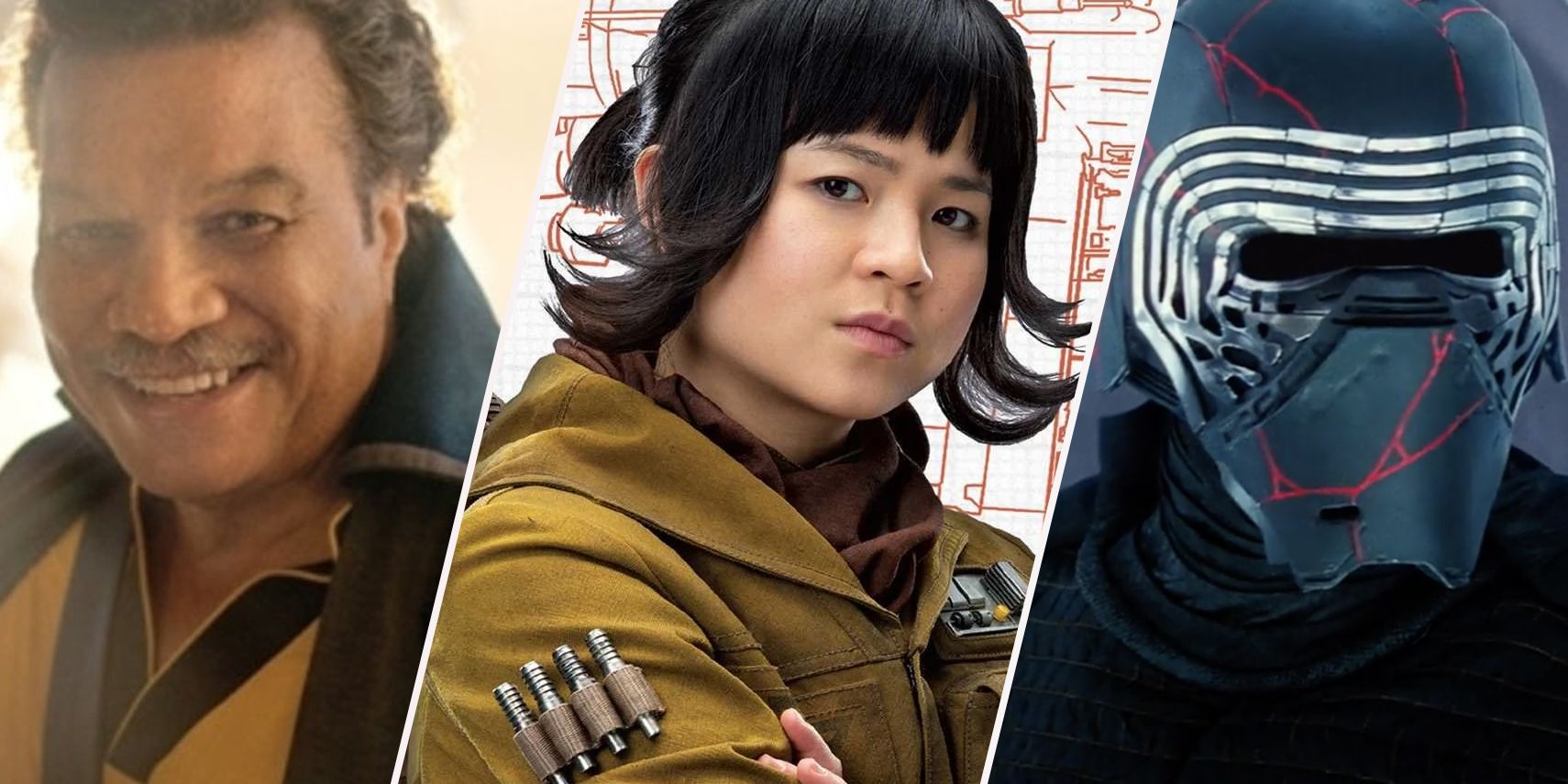
To put it nicely, the Star Wars sequel trilogy fell short of expectations. Each movie has its own flaws but together, they all suffer from catering too much to fan demands. Fanservice is good in doses, but the new Star Wars movies showed how too much is detrimental to the story.
In more instances than one, the sequel trilogy traded creative dares and risks for safe and predictable nostalgic callbacks and fanservice. Instead of challenging the status quo, all the movies did was validate fans’ love for a trilogy that’s nearly 40 years old at this point.
10 Everything About Starkiller Base
In a lot of ways, The Force Awakens is a soft remake of the original Star Wars. Nowhere is this more obvious than its main conflict, where the Resistance takes down Starkiller Base: a planet converted into an Imperial galaxy-killing superweapon. Other than being the Death Star but bigger, Starkiller Base has no creative or interesting reason to exist.
In hindsight, Starkiller Base was literally the biggest warning that the sequel trilogy was nothing but a comfort blanket of familiarity for fans. This warning shot paid off in The Rise of Skywalker, which featured a giant fleet of Star Destroyers for no other reason than being an armada of ships that fans recognized.
9 Rey Inheriting The Millennium Falcon
When the First Order tracks Finn to Jakku, he, Rey, and BB8 make a mad dash for the closest ship they could find: the Millennium Falcon. From then on, Rey is tied to the Falcon. In fact, she inherits it when Han Solo – its most famous pilot – dies at the hands of his son, Kylo Ren.
In The Force Awakens, this was an amazing discovery. When taking the trilogy into account, it reeks of pandering. The only reason why Rey didn’t find any other ship or maybe create one herself was because the movies needed a reason to bring back Han Solo and Chewbacca. Iconic as it is, the Falcon didn’t serve any other purpose than validating nostalgia.
8 Bringing Back Lando Calrissian For No Reason
The entire sequel trilogy is guilty of bringing back older characters for no particular reason, with ex-Cloud City mayor Lando Calrissian being the most egregious. Lando reappears in The Rise of Skywalker to provide some exposition and lead the cavalry in the final battle. Beyond those, he has no other purpose whatsoever.
He may not be a part of the main trio, but Lando was an important Star Wars character who boasted some of the trilogy’s most layered characterization. This was thanks to him being a politician who was forced to betray his friends to the Empire, only to redeem himself by joining the revolution. None of this complexity or nuance was present in his fan-pleasing return.
7 Rebuilding Luke Skywalker’s Pedestal
The Last Jedi polarized fans because it dared question the very foundation of Star Wars, with Luke Skywalker’s status as a paragon being the biggest. The divisive sequel revealed that Luke became a cynical recluse after he effectively gave rise to the First Order by attempting to kill Ben Solo, who then became Kylo Ren when he defected to the First Order.
Instead of doubling down on Luke’s very human follies, The Rise of Skywalker restored his perfect status because that’s how fans remembered him. Not only did he apologize for not living up to Rey’s (read: fans’) expectations, but he even caught a lightsaber that Rey threw, a clear counter to a similar scene from The Last Jedi. This is worse in the comics, where Rey loses all personality to become Luke’s biggest fangirl.
6 Retroactively Making Emperor Palpatine The Source Of All Evil
For the longest time, it was inferred that the conflicts in Star Wars were only symptoms of the greater, abstract clash between the Light and Dark sides of the Force. The sequel trilogy changes this for the worse, where it’s’ revealed that pretty much everything – from the prequel trilogy to Kylo Ren’s betrayal – is Emperor Palpatine’s fault because it’s the easiest fan theory around.
With no prior build-up whatsoever, The Rise of Skywalker reveals that Palpatine survived being thrown down a shaft in Return of the Jedi and has been orchestrating everything since then. Not only does this deny the First Order of its agency and threat as a new force of evil, but it also nullifies the dramatic weight and necessity of Darth Vader’s final sacrifice.
5 Sticking To The Rebel Vs. Empire Conflict
The central conflict of Star Wars is the titular war between the Rebels and the Galactic Empire, which were rebranded into the Resistance and First Order, respectively. Minus minor changes, the sequel trilogy recreated the Galactic Civil War for familiarity’s sake.
The Last Jedi attempted to change this, with Kylo Ren offering Rey the chance to end the war since it’s doomed to repeat a generation later. This daring move was never followed through, as The Rise of Skywalker regressed to the Resistance fighting the First Order for broad reasons. Any opportunities to comment on history’s dark habit of repetition were promptly ignored.
4 Not Allowing Kylo Ren To Forge His Own Villainous Path
By default, Kylo Ren is the most interesting character in the sequel trilogy. He started out as a dedicated Sith disciple who broke free in The Last Jedi, setting him up to be the final antagonist who emerged from the ashes of the First Order and Resistance. However, Kylo becomes a lackey yet again in The Rise of Skywalker.
Any promise Kylo had in becoming his own villain were crushed, as he bowed to Emperor Palpatine. Worse, the finale tried to redeem Kylo not to show that it’s never too late for anyone, but because Darth Vader had a redemption arc in Return of the Jedi. In the end, Kylo never outgrew his starting point as a Darth Vader clone and fanboy.
3 Giving Rey An Important Bloodline
One of the biggest revelations in The Last Jedi was that Rey had no bloodline; her parents were drunkards who sold her to a junker for beer money. This wasn’t a bad thing, though, since it meant that even a nobody like Rey could shape the galaxy’s destiny for the better.
Unfortunately, The Rise of Skywalker rewrote this to appease incessant fan theorists who demanded that Rey be connected to an established character. For fanservice’s sake, it’s revealed that Rey is the granddaughter of Emperor Palpatine. As a result, Rey’s individuality was robbed and all her accomplishments were now the result of her bloodline instead of her willpower.
2 Rey Takes Up The Skywalker Name
For whatever contrived reason, Rey ends The Rise of Skywalker by adopting the Skywalker name. This doesn’t make sense because her time with a bitter Luke wasn’t exactly the best and she only had sporadic interactions with Leia. Those aside, it’s one of the sequel trilogy’s most transparent instances of fan pandering.
Rey took up the Skywalker name not because she felt that it was a legacy needing preservation, but because fans said so. Worse, Rey becoming a Skywalker means that Emperor Palpatine got what he wanted in death. Palpatine has been trying to own the Skywalkers ever since the prequels and his granddaughter adopting the name cemented his victory.
1 Pushing Rose Tico Out Of The Picture
The worst way that the sequel trilogy bowed down to fan demand was its treatment of Rose Tico. For more unfair reasons than anyone could count, Star Wars’ first Asian protagonist became a lightning rod of undeserved hate. Worse, her actress Kelly Marie Tran was targeted by hateful racist campaigns on social media. Rather than stand behind Rose and Kelly, The Rise of Skywalker seemingly succumbed to the pressure mounted by the fanbase’s worst sectors.
Rose was all but erased from the finale, having exactly 76 seconds’ worth of screen time and with all of her story beats and teases unceremoniously scrapped. The filmmakers claim this was done in light of Carrie Fisher’s passing since Rose (reportedly) had planned scenes with Leia, but this excuse did little to hide the obvious.
About The Author