WARNING: The following contains spoilers for Zack Snyder’s Justice League, now streaming on HBO Max.
At four hours long, Zack Snyder’s Justice League extends many fight sequences that appeared in the 2017 theatrical cut of the film. It’s no surprise that Snyder’s cut adds a lot more violence, given his style in the DC Extended Universe and in comic book movies like 300 and Watchmen. This adds more depth to his heroes, displaying them as true warriors.
Interestingly, Snyder’s strategy does drastically improve one key fight in this cut, however, it doesn’t fix a problem initially laid down in his previous DCEU films.
Click the button below to start this article in quick view.
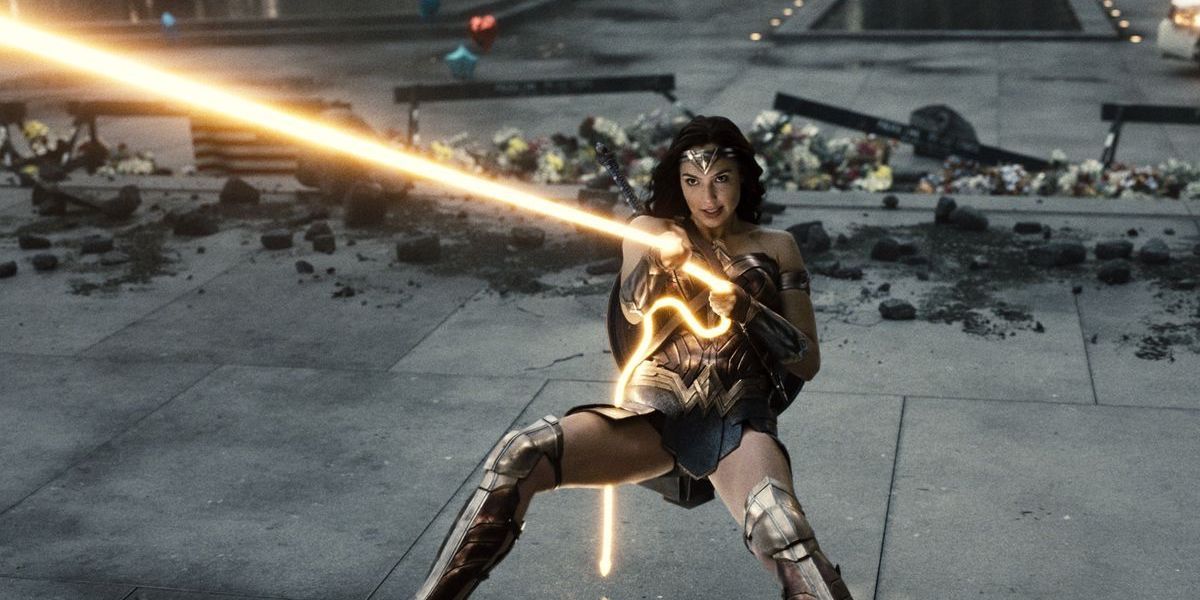
In the London bank scene, the theatrical cut had Wonder Woman going after terrorists who wanted to destroy Europe’s economy and take them back to the dark ages. Although it was a decent sequence, it felt compressed in the two hour run of the film and didn’t really showcase anything else besides how quickly she could move to block bullets.
Snyder’s version, however, allows Diana to flourish, using her super-speed to zoom around the room, punching, kicking and slamming opponents into the ground. There’s even one cool video game-esque shot where she catches a thug she punches mid-air, races over to intercept his trajectory and then flings him into the wall like a sack of flour.
In addition, when she grabs the bomb, she flies up through the roof, into the sky and then tosses it up so it can detonate. Snyder plays up her ability to fly a bit more whereas Whedon’s version made it seem like she just leapt to the top floor and threw the briefcase away. This is more in keeping with Patty Jenkins’ two Wonder Woman films, which take place earlier in the DCEU timeline. Apart from that cohesiveness, when she comes back down, she gets more air time as she stops the boss from shooting up a group of kids, but this is where the problem lies.
As the boss stands in disbelief, asking what she really is, Diana clashes her gauntlet and blows him away. Whedon’s version cuts it right at the glow, but Snyder extends it to show the building being blown away and the man’s hat falling below to the ground, covered in ash. Safe to say, at this point, the villain’s either been incinerated or blown through the building, falling to his death. Moreover, all of the falling rubble comes close to killing a group of cops, who had cordoned off the area.
Basically, Diana willingly kills the man, which evokes the moment when Superman killed Zod in Man of Steel. Many felt Kal-El shouldn’t have snapped his neck and instead found a way to block his heat vision from frying civilians. His actions are a little more understandable as Zod was refusing to back down but in this case, Snyder doubles down on the gratuitous aggression. Diana could have taken the man down by any other means, such as with her lasso, but chose not to.
Even worse, when a young girl says she wants to be like her, Diana replies that she can be anything she wants to be. It’s rather jarring to juxtapose that emotional, sentimental moment with Diana’s previous action of committing cold-blooded murder. She set no example at all, making this attempt at a warm epilogue feel unnatural and forced. More so, it reaffirms the argument of the other heroes, even the bitter Batman, that these gods among men really have no problem playing judge, jury and executioner when they should be finding other moral solutions to bring people to justice.
Zack Snyder’s Justice League stars Ben Affleck as Batman, Gal Gadot as Wonder Woman, Henry Cavill as Superman, Amy Adams as Lois Lane, Jason Momoa as Aquaman, Ezra Miller as The Flash, Ray Fisher as Cyborg, Jeremy Irons as Alfred Pennyworth, Diane Lane as Martha Kent, Ray Porter as Darkseid, Ciarán Hinds as Steppenwolf, Jesse Eisenberg as Lex Luthor and J.K. Simmons as Commissioner Gordon. The film is currently available on HBO Max.
About The Author
