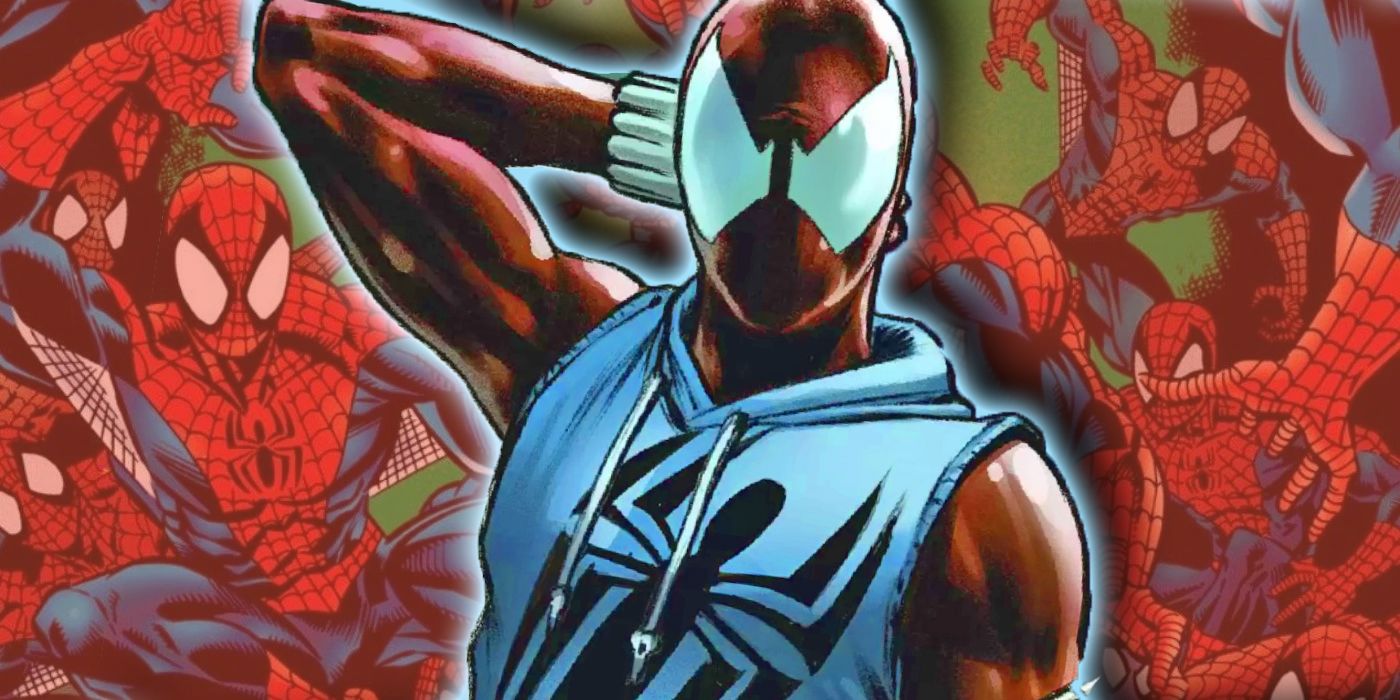
WARNING: The following contains minor spoilers for Iron Man #7, by Christopher Cantwell, Cafu, Frank D’Armata and VC’s Joe Caramagna, one sale now.
The Scarlet Spider has a rather complicated history, to put it mildly. As infamously detailed in the years-long Spider-Man story, “The Clone Saga,” Ben Reilly has struggled with being Peter Parker‘s clone for his entire existence. And on his most recent mission, the Scarlet Spider confirmed just how difficult being a clone still is.
In Iron Man #7, by Christopher Cantwell and Cafu, the Scarlet Spider is part of a ragtag group that Iron Man has assembled to assist him against Korvac. While traveling out in space, the group is discussing the nature of existence. Misty Knight wonders if there’s a difference between a god or the Judeo-Christian God. When she says this, Ben Reilly has a very scientific response, claiming that sentient beings are nothing more than cells, molecules and atoms.
Click the button below to start this article in quick view.
According to Ben, people end up forming their own consciousness randomly, once their bodies are held together by muscular reflexes. Of course, Frog-Man points out that the Scarlet Spider is a “test-tube clone,” attributing his scientific answer to his infamous origin.
For the rest of the conversation, the Scarlet Spider stays pretty quiet, seemingly wounded by being called a “test-tube clone.” Despite the apparent innocuousness of the comment, Frog-Man appears to have hit a nerve with Reilly that touches on his continuing struggle with the very nature of his existence.
Since his first appearance in 1975’s Amazing Spider-Man #149, by Gerry Conway and Ross Andru, Ben has struggled to find his own identity. Ben was introduced as a Spider-Man clone created by the Jackal. Seemingly killed at the end of his battle with Peter Parker, Ben was initially nothing more than a mere copy.
Still, Ben survived and resurfaced resurfacing years later in 1994’s Spectacular Spider-Man #216, by Tom DeFalco, Todd DeZago and Sal Buscema. For years, Ben tried to become his own person, living far away from Peter. Ben adopted a new name and a new home, but he couldn’t stay away for long. The entire reason that Ben returned to New York was to see Aunt May, who was dying. Clearly, no matter how hard he tried, Ben couldn’t disconnect himself from Peter’s life.
In Web of Spider-Man #128, by DeFalco, DeZago and Steven Butler, Ben got a new lease on life. Believing himself to be the original Peter Parker, the Scarlet Spider became the new Spider-Man. At the time, Ben also claimed that he and Peter were different, acknowledging how he no longer identified as Peter Parker, but as Ben Reilly. Feeling a greater sense of identity, Ben had a more positive outlook on his life. For a time, Ben embraced his life and enjoyed being who he was.
This happiness wasn’t to last, however. In Spider-Man #75, by Howard Mackie and John Romita Jr., Ben was killed by the Green Goblin. When Ben died, he disintegrated, revealing himself as a clone after all. It wasn’t until Amazing Spider-Man #16, by Dan Slott and Giuseppe Camuncoli, that Ben came back to life. At this point, Ben’s view of existence had shifted to a much darker state.
It was revealed, in Amazing Spider-Man #22, by Slott, Christos Gage and Camuncoli, that the original Jackal had killed and resurrected him many times, traumatizing the former Scarlet Spider. It’s easy to see how dying and coming back so many times would make Ben see himself as little more than a science experiment gone wrong.
As the new Jackal, Ben Reilly created his own clones of several dead allies and enemies from Spider-Man’s world. This new project illustrated Ben’s shifting views on existence, believing that, simply by replicating others’ cellular structure, he could restore their old lives.
Of course, most of these clones disintegrated due to the Carrion Virus. Now, the Scarlet Spider must be very disillusioned with the nature of existence. After several instances of death, resurrection and questioning his own identity, the Scarlet Spider has experienced enough turmoil for several lifetimes. Following these struggles to grasp his own existence, the Scarlet Spider still finds it difficult to see life as anything more than hard science.
About The Author