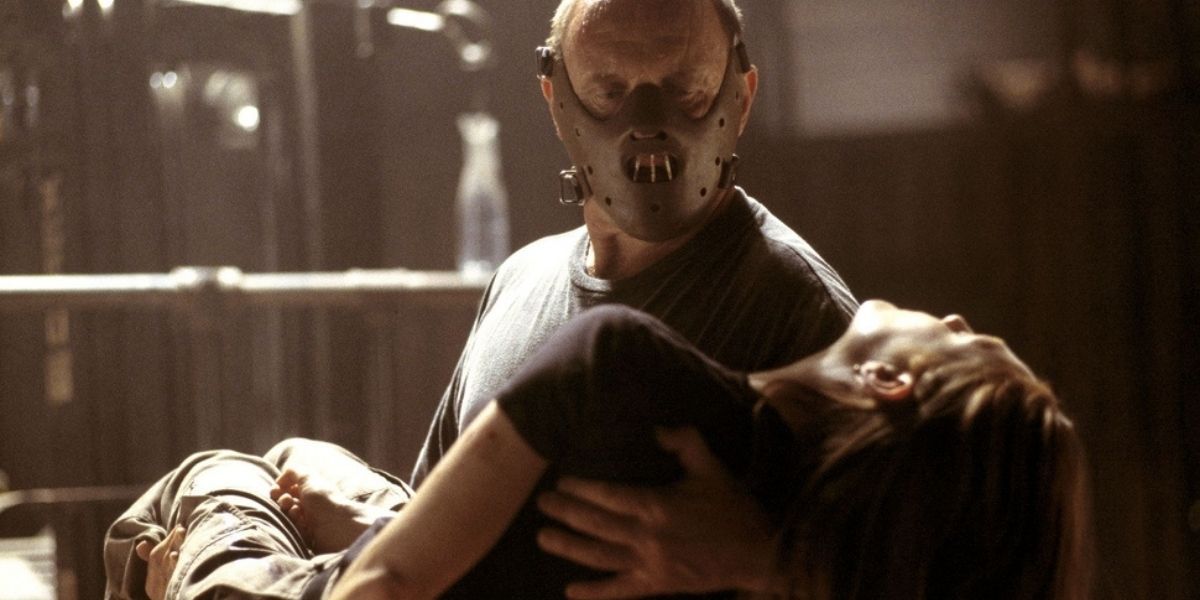
Clarice Starling, the eponymous protagonist of Clarice, is Hannibal Lecter’s opposite in every sense of the word. His amoral and blasé outlook in old age contrasts sharply with her youth, uprightness, and strong sense of duty. Hannibal’s very presence paints him as a harbinger of death in direct opposition to Clarice Starling’s innocence and devotion to justice. With this in mind, many readers protested when Thomas Harris ended his novel, Hannibal, with Clarice Starling and Hannibal Lecter becoming lovers.
The Silence of the Lambs averted this outcome by putting Hannibal on a plane, far from the reach of the FBI, and placing Clarice Starling back on her pedestal. However, now that CBS’s Clarice is exploring the time between this film and Hannibal, it’s worth examining why it’s unlikely that filmmakers will ever adapt Thomas Harris’s original vision.
Click the button below to start this article in quick view.
The first big problem stems from intellectual property issues. Clarice and Hannibal cannot appear together on-screen because CBS only holds the rights to characters that first appeared in The Silence of the Lambs. These rights exclude Hannibal Lecter, whose first appearance was in Red Dragon. Marta di Laurentiis owns the rights to the other Hannibal novels. The second big reason is that Thomas Harris wasn’t trying to turn Clarice and Hannibal into an item in The Silence of the Lambs. He wanted to craft a female character interesting as Black Sunday‘s Dahlia Iyad. Hannibal Lecter, his brainchild from Red Dragon, proved to be a valuable device for revealing more of her personality to the reader.
Clarice’s most prominent opposition in The Silence of the Lambs was the uncooperative and patriarchal infrastructure of the FBI and her colleagues, who obstructed her path at every turn. The same proves true in Clarice: her male colleagues go so far as to keep her bound and drugged for most of the episode “Get Right with God.” Throughout the series thus far, Clarice struggles with fighting her nigh-insurmountable personal and professional battles in the aftermath of the Buffalo Bill case. On top of that, she is haunted by Jame Gumb’s surviving victim, Catherine Martin, who has regressed into a state of profound emotional frailty — the kind of fragile vulnerability that Clarice fears most.
In Hannibal, Harris excelled at using the same elements that Clarice is developing — structural machismo, institutional corruption, and constant objectification and victimization of women — to arm Lecter with ironclad arguments to persude Clarice to join him. Hannibal reasons that he and Clarice are more competent than everyone around them and consistently punished for it. Why should she chain herself to a life of drudgery when she’s so worth so much more? Despite their completely different values, he surmises, aren’t they under fire from the same enemies? Most importantly, is eating the brains of your co-worker that evil when he’s constantly thinking about all the ways he can screw you over?
The main issue with Harris’s ending is not that Clarice chooses to become Hannibal’s lover. In a vacuum, they are an immensely compelling couple to read about or watch. However, Harris stripped Clarice of her freedom and agency before their relationship began. In the novel, Hannibal kidnaps, restrains, and unsuccessfully brainwashes Clarice into thinking that she’s his beloved little sister, Misha. Afterward, Clarice is still heavily drugged and hypnotized when she attempts to seduce Hannibal. In the process, he loses his quasi-supernatural allure in exchange for a highly toxic co-dependent relationship. Their last pages together are equal parts glamourous, intimate, and disconcerting.
As bleak as it was, this ending works in the context of a meticulously-planned horror-thriller novel. The written form allows much more room to explore these moral and ethical gray areas in detail from a plethora of perspectives. However, it would never fly on the silver screen, especially when none of the actors considered this angle for their performances. Jodie Foster’s rendition turned Clarice Starling into one of cinema’s most compelling heroines and a feminist icon. It would have been horrifying to see this resolute character turn into a shadow of herself or a shallow reflection of Hannibal’s obsessions. The film adaptation of The Silence of the Lambs avoids this fate when Hannibal cuts his hand to keep his freedom and avoid hurting Clarice. The act is gruesome yet morbidly romantic and offers infinite sequel potential that keeps the fanbase generally satisfied.
Clarice has a lot to work around between licensing issues that prevent the actors from naming Hannibal Lecter, the widespread distaste for the novel’s original ending, and the fact that the show takes place barely a year after The Silence of the Lambs. These circumstances also ensure that the chances of any Hannibal sightings, let alone a romantic ending with the titular heroine, are zero. The closest thing fans will get to this outcome is Bryan Fuller’s Hannibal series for NBC, and even Fuller balked at letting Hannibal Lecter and Will Graham get a happily ever after.
Starring Rebecca Breeds, Michael Cudlitz, Kal Penn, Nick Sandow, Lucca De Oliveira, Devyn A. Tyler, and Marnee Carpenter, Clarice airs Thursdays at 10 p.m. ET/PT on CBS.
About The Author
